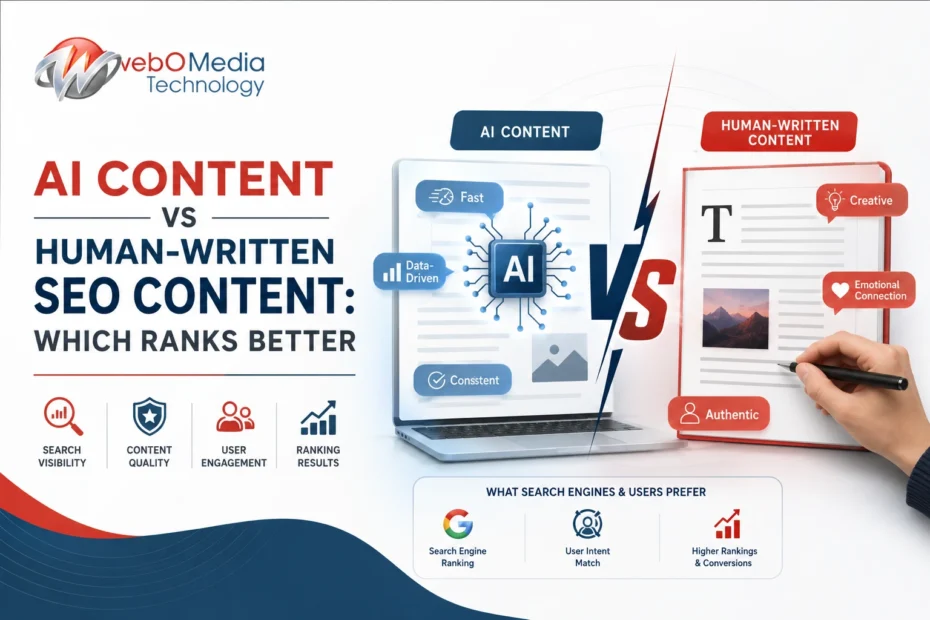

Artificial intelligence has transformed the way content is created. From generating blog posts and product descriptions to writing emails and social media captions, AI tools have become an essential part of many marketers’ workflows. But as AI-generated content becomes more common, one question continues to spark debate among SEO professionals and business owners:
Is AI content better than human-written SEO content?
The answer isn’t as simple as choosing one over the other. Both AI-generated and human-written content have unique strengths and limitations. While AI can speed up content production and assist with research, human writers bring creativity, experience, emotion, and strategic thinking that machines cannot fully replicate.
If your goal is to rank higher on Google while building trust with your audience, understanding the differences between AI and human-written content is essential.
In this guide, we’ll compare AI content and human-written SEO content, explore their advantages and disadvantages, and explain which approach delivers the best long-term SEO results.
What Is AI-Generated Content?
AI-generated content refers to text created with the help of artificial intelligence models that analyze patterns from vast amounts of data and generate human-like responses based on user prompts.
Today, AI tools can create:
- Blog articles
- Product descriptions
- Email copy
- Landing pages
- Social media posts
- Website content
- Ad copy
- FAQs
- Content outlines
These tools help businesses produce content faster and reduce the time spent on drafting initial versions.
However, AI relies on existing patterns and information rather than personal experience or original insights.
What Is Human-Written SEO Content?
Human-written SEO content is created by professional writers who combine industry expertise, creativity, storytelling, audience understanding, and search engine optimization techniques to produce valuable and engaging content.
Unlike AI, human writers can incorporate personal experiences, critical thinking, real-world examples, emotional appeal, and unique perspectives that resonate with readers.
A skilled SEO writer doesn’t just target keywords—they create content that answers questions, solves problems, and builds trust with the audience while aligning with search engine best practices.
This human element often makes content more authentic, persuasive, and memorable.
AI Content vs Human-Written SEO Content: Understanding the Difference
Although both approaches aim to provide information, the way they achieve that goal differs significantly.
AI focuses on speed, automation, and pattern recognition, while human writers focus on context, creativity, and meaningful communication.
AI can generate thousands of words within minutes, making it an excellent productivity tool. Human writers, on the other hand, invest time researching topics, understanding user intent, and crafting content that reflects expertise and originality.
The biggest difference lies in the ability to think critically. Human writers can interpret complex topics, express emotions, and adapt tone based on audience expectations, whereas AI generates responses based on learned language patterns.
For businesses seeking long-term authority and audience trust, this distinction becomes increasingly important.
Why Human-Written Content Builds Stronger Audience Trust
People connect with stories, experiences, and genuine expertise. Human-written content naturally includes these elements because it reflects personal understanding rather than statistical prediction.
Readers are more likely to trust content that demonstrates first-hand knowledge, practical advice, and authentic opinions.
A professional writer understands how to simplify complicated ideas, address audience concerns, and communicate with empathy.
These qualities help create stronger relationships between brands and their audiences, leading to increased engagement, higher conversion rates, and greater customer loyalty.
Trust is difficult to automate, making human-written content especially valuable for industries where credibility matters.
Benefits of AI-Generated Content
AI has become an invaluable tool for marketers because it dramatically improves efficiency.
Some of its biggest advantages include:
- Produces content quickly
- Generates multiple topic ideas
- Creates first drafts within minutes
- Helps overcome writer’s block
- Assists with keyword research
- Supports content scaling
- Reduces production costs
- Improves workflow efficiency
For businesses managing large content calendars, AI can significantly accelerate production without sacrificing consistency.
However, speed alone does not guarantee quality or long-term SEO success.
Benefits of Human-Written SEO Content
Human writers bring qualities that technology cannot easily reproduce.
Professionally written content offers:
- Original insights and perspectives
- Emotional storytelling
- Better audience engagement
- Industry expertise
- Contextual understanding
- Stronger brand voice
- Higher credibility
- Better alignment with user intent
Because humans understand cultural nuances and audience psychology, they can create content that feels natural, persuasive, and genuinely helpful.
This often results in longer session durations, lower bounce rates, and improved user satisfaction.
Which Content Performs Better for SEO?
Search engines don’t rank content simply because it was written by AI or a human. They prioritize content that is helpful, accurate, original, and valuable to users.
Google’s focus remains on content quality rather than the method used to create it.
That means an AI-generated article can perform well if it provides useful information and meets user expectations. Likewise, poorly written human content may struggle to rank despite being entirely original.
The strongest SEO content typically combines:
- Comprehensive topic coverage
- Clear structure
- Accurate information
- User-focused writing
- Original insights
- Demonstrated expertise
- Strong readability
- Effective keyword optimization
Ultimately, content quality matters far more than the writing method.
The Role of EEAT in Modern SEO
Google increasingly emphasizes Experience, Expertise, Authoritativeness, and Trustworthiness (EEAT) when evaluating content quality.
Human writers naturally contribute to these signals by sharing practical knowledge, industry experience, and authentic perspectives.
AI can summarize information effectively, but it cannot genuinely claim personal experience or professional expertise.
For industries such as healthcare, finance, legal services, and business consulting, demonstrating real expertise becomes essential for long-term rankings and audience trust.
Adding case studies, expert opinions, original research, and practical examples strengthens EEAT and improves content quality.
Can AI Content Rank on Google?
Yes, AI-generated content can rank well if it meets Google’s quality standards and provides genuine value to users.
Google does not automatically penalize content because it was created with AI assistance.
However, content produced solely for manipulating rankings without offering useful information may perform poorly over time.
AI-generated articles should always be reviewed, fact-checked, expanded with original insights, and edited to ensure accuracy and readability before publication.
The goal should be to create helpful content—not simply publish content faster.
The Best Approach: AI Plus Human Expertise
Rather than choosing between AI and human writers, many successful businesses combine both approaches.
AI can assist with:
- Research
- Content outlines
- Topic brainstorming
- Draft generation
- Keyword suggestions
- Content optimization
Human writers then refine the content by:
- Adding original insights
- Improving readability
- Strengthening brand voice
- Including real examples
- Fact-checking information
- Enhancing storytelling
- Optimizing for user intent
This hybrid approach combines the efficiency of AI with the creativity and strategic thinking of human expertise.
For most businesses, it offers the best balance between scalability and quality.
Common Mistakes When Using AI for SEO Content
Many websites fail to achieve results because they rely entirely on unedited AI-generated text.
Common mistakes include:
- Publishing content without editing
- Ignoring factual inaccuracies
- Keyword stuffing
- Repetitive phrasing
- Generic explanations
- Lack of originality
- Missing expert insights
- Weak internal linking strategy
Treating AI as an assistant rather than a replacement for professional writers produces significantly better outcomes.
Best Practices for Creating High-Quality SEO Content
Whether using AI, human writers, or both, successful SEO content should follow these principles:
- Focus on solving user problems.
- Write naturally for people first.
- Cover topics comprehensively.
- Use clear headings and structure.
- Include original examples and insights.
- Optimize keywords naturally.
- Keep information accurate and up to date.
- Build trust through expertise and transparency.
The best-performing content is always created with the audience’s needs in mind rather than search engines alone.
Frequently Asked Questions
1. Is AI content better than human-written SEO content?
AI content is faster to produce, while human-written content typically offers greater creativity, originality, and emotional connection. The best results often come from combining both.
2. Can AI-generated content rank on Google?
Yes. Google evaluates content based on quality and usefulness rather than whether it was written by AI or a human.
3. Does Google penalize AI content?
Google does not penalize AI-generated content simply because it uses AI. Low-quality, spammy, or unhelpful content—regardless of how it is created—may perform poorly.
4. Why is human-written content important for SEO?
Human writers provide unique insights, real-world experience, storytelling, and audience understanding that improve engagement and strengthen trust.
5. What is the best strategy for content marketing?
A hybrid strategy that combines AI-powered efficiency with human expertise and editorial review often delivers the strongest SEO and business results.
Final Thoughts
The debate around AI content vs human-written SEO content isn’t about choosing one over the other—it’s about understanding how each can contribute to a successful content strategy.
AI excels at accelerating research, generating ideas, and improving productivity, while human writers bring creativity, expertise, emotional intelligence, and strategic thinking that build trust and authority.
For businesses focused on sustainable SEO growth, the most effective approach is to use AI as a powerful assistant and rely on human expertise to refine, personalize, and elevate the final content. When technology and human creativity work together, the result is content that not only ranks well but also delivers real value to readers and strengthens long-term brand credibility.
