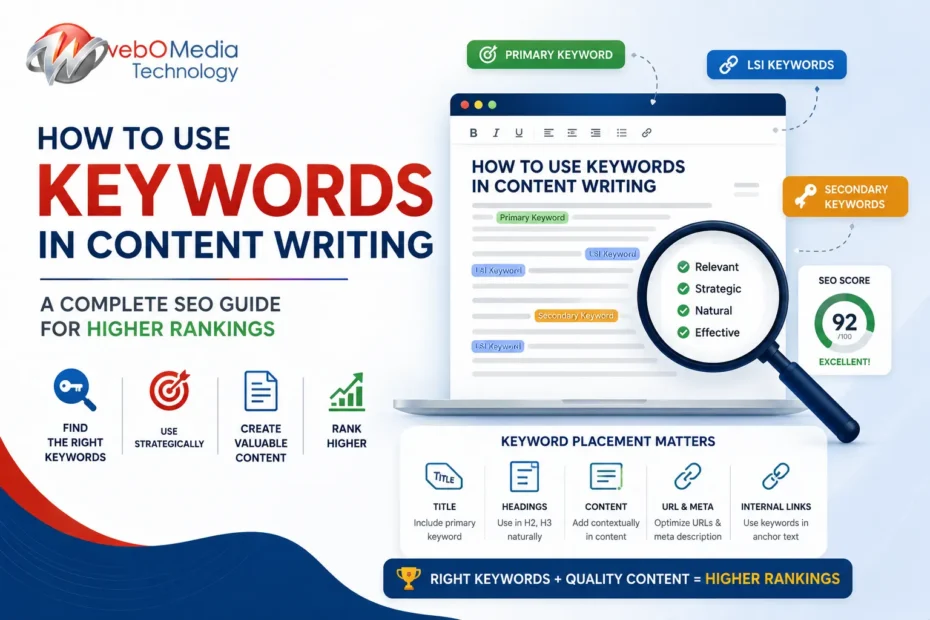

Creating high-quality content is no longer just about writing informative articles. To help your content reach the right audience, you also need to understand how to use keywords in content writing effectively. Keywords act as a bridge between what people search for and the information your content provides.
However, modern SEO has changed significantly. Gone are the days when repeating the same keyword dozens of times could improve rankings. Google’s algorithms now prioritize helpful, people-first content that satisfies search intent while using keywords naturally and contextually.
Whether you’re a beginner, blogger, business owner, or SEO content writer, learning the right way to place keywords can improve your content’s visibility, increase organic traffic, and enhance user experience without making your writing feel forced.
In this comprehensive guide, you’ll learn where to use keywords, how often to use them, common mistakes to avoid, and the best keyword optimization strategies for Google SEO in 2026.
What Are Keywords in Content Writing?
Keywords are the words and phrases that users type into search engines when looking for information, products, or services online. They help search engines understand what your content is about and determine whether it matches a user’s search intent.
For example, if someone searches for “how to use keywords in content writing,” Google looks for pages that thoroughly answer that question using relevant terms, natural language, and helpful information.
Today’s SEO isn’t about targeting a single keyword repeatedly. Instead, it involves using a combination of primary keywords, secondary keywords, semantic keywords, and related phrases that comprehensively cover the topic.
When keywords are used strategically, they improve both search visibility and the overall reading experience.
Why Are Keywords Important in SEO Content Writing?
Keywords play a crucial role in connecting your content with the right audience. They help search engines understand the purpose of your page while ensuring users find answers to their questions quickly.
Using keywords correctly can:
- Improve search engine rankings.
- Increase organic website traffic.
- Help search engines understand your content.
- Target the right audience.
- Improve click-through rates (CTR).
- Support topical authority.
- Enhance user experience.
- Increase conversions.
However, keywords should always support valuable content rather than dominate it. Google rewards pages that answer questions naturally instead of focusing solely on keyword repetition.
Understanding Different Types of Keywords
Before writing any SEO content, it’s important to understand that not all keywords serve the same purpose.
- Primary keywords represent the main topic of your article and should appear naturally throughout the content.
2. Secondary keywords support the primary keyword by covering closely related search queries and variations.
3. Long-tail keywords are longer, more specific search phrases that often have lower competition and higher conversion potential because they target users with clear intent.
4. Semantic keywords include related words, synonyms, and contextual phrases that help search engines understand the broader meaning of your content.
Using a healthy mix of these keyword types allows you to create comprehensive, user-focused articles that align with Google’s understanding of topics rather than isolated phrases.
Also Read : AI Content vs Human-Written SEO Content: Which Is Better for Rankings and User Engagement?
How to Choose the Right Keywords Before Writing
Effective keyword optimization begins long before the first paragraph is written.
Start by identifying what your audience is searching for and the intent behind those searches. Instead of choosing keywords based only on search volume, consider relevance, competition, and how well they match your expertise.
When selecting keywords, look for:
- High relevance to your topic.
- Clear search intent.
- Reasonable competition.
- Good monthly search volume.
- Long-tail keyword opportunities.
- Related questions from users.
Keyword research tools can help you discover these opportunities, but your final selection should always prioritize user needs over metrics alone.
Where Should You Use Keywords in Content?
Knowing where to place keywords is just as important as choosing the right ones.
Strategically placing keywords helps search engines understand your content without affecting readability.
Your primary keyword should naturally appear in:
- The page title.
- SEO title tag.
- Meta description.
- URL slug.
- Introduction.
- First 100 words.
- Main H1 heading.
- At least one H2 heading.
- Several H3 headings where relevant.
- Image alt text (when appropriate).
- Conclusion.
Secondary and semantic keywords should be distributed naturally throughout the article wherever they fit the context.
Avoid inserting keywords where they don’t belong, as unnatural placement reduces readability and may negatively affect user experience.
How to Use Keywords Naturally in Content Writing
One of the biggest mistakes writers make is forcing keywords into every paragraph.
Instead, write naturally for your audience first, then optimize for search engines.
A well-written article should read like a conversation rather than a collection of repeated search terms.
Rather than repeating the exact keyword multiple times, vary your language using synonyms, related concepts, and semantic phrases.
For example, instead of repeatedly writing “how to use keywords in content writing,” you might also use phrases like:
- keyword placement
- SEO keyword optimization
- writing SEO-friendly content
- content optimization
- keyword strategy
- optimizing blog content
This approach makes your writing more engaging while helping search engines understand your topic more comprehensively.
Understanding Keyword Placement Without Keyword Stuffing
Keyword placement should feel natural rather than mechanical.
Google’s algorithms are sophisticated enough to recognize context, meaning, and topic relevance without relying on excessive keyword repetition.
Instead of aiming for a specific keyword density, focus on covering the subject thoroughly.
Every keyword should appear because it contributes meaningfully to the discussion—not simply because you’re trying to increase its frequency.
When readers don’t notice the optimization, you’ve usually done it correctly.
The Importance of Search Intent in Keyword Optimization
Search intent is one of the most important ranking factors in modern SEO.
Before using any keyword, ask yourself why someone would search for it.
Generally, search intent falls into four categories:
- Informational (learning something)
- Navigational (finding a specific website)
- Commercial (researching products or services)
- Transactional (ready to make a purchase)
Your content should match the user’s intent as closely as possible.
For example, someone searching “how to use keywords in content writing” expects practical guidance—not a sales page promoting SEO services.
When your content aligns with user intent, it naturally performs better in search results.
How Many Keywords Should You Use in a Blog Post?
There is no fixed number of keywords required for successful SEO.
Instead of counting keywords, focus on creating comprehensive content that covers the topic from multiple angles.
A well-optimized article typically includes:
- One primary keyword.
- Several secondary keywords.
- Multiple semantic keywords.
- Naturally occurring related phrases.
This creates topical depth and helps search engines understand the full context of your article.
Quality always outweighs quantity.
Also Read : Can Adding More Pictures Increase SEO? What Actually Helps Rankings in 2026
Common Keyword Mistakes to Avoid
Even experienced writers occasionally make keyword optimization mistakes.
Some of the most common include:
- Keyword stuffing.
- Targeting multiple unrelated primary keywords.
- Ignoring search intent.
- Over-optimizing headings.
- Using unnatural anchor text.
- Repeating identical phrases excessively.
- Writing for search engines instead of readers.
- Ignoring semantic keywords.
- Forgetting image optimization.
- Neglecting internal linking.
Avoiding these mistakes improves readability and helps your content remain compliant with Google’s people-first content guidelines.
Best Practices for Keyword Optimization
Successful keyword optimization combines strategic planning with natural writing.
Some proven best practices include:
- Research keywords before writing.
- Focus on one primary topic per page.
- Write naturally for readers.
- Use semantic and related keywords.
- Optimize headings logically.
- Add internal and external links where relevant.
- Optimize images with descriptive alt text.
- Keep URLs short and keyword-focused.
- Write compelling meta titles and descriptions.
- Update older content with new keywords and information.
Following these practices creates content that is both user-friendly and search-engine friendly.
How Google Evaluates Keyword Usage Today
Modern Google algorithms no longer rank pages based simply on keyword frequency.
Instead, they evaluate whether your content demonstrates:
- Relevance.
- Helpfulness.
- Originality.
- Context.
- Expertise.
- User satisfaction.
- Topical authority.
- Comprehensive coverage.
Google understands synonyms, related entities, natural language, and search intent better than ever before.
This means successful SEO writing focuses on answering questions thoroughly rather than repeating keywords unnecessarily.
Frequently Asked Questions
1. How do you use keywords naturally in content writing?
Use keywords where they fit naturally within headings, introductions, body paragraphs, image alt text, and conclusions while maintaining smooth, conversational writing. Avoid forcing keywords into sentences where they don’t belong.
2. What is the ideal keyword density?
There is no officially recommended keyword density. Instead of aiming for a percentage, focus on writing naturally and covering the topic comprehensively using relevant terms and semantic keywords.
3. Where should the primary keyword appear?
The primary keyword should appear in the title, URL, meta description, introduction, H1 heading, at least one H2 heading, and naturally throughout the content where relevant.
4. Can using too many keywords hurt SEO?
Yes. Excessive keyword repetition, also known as keyword stuffing, can reduce readability and may negatively affect search performance because it creates a poor user experience.
5. Should I use synonyms and related keywords?
Absolutely. Using semantic keywords, synonyms, and related phrases helps search engines understand your topic more effectively while making your content more engaging for readers.
Final Thoughts
Learning how to use keywords in content writing is about much more than inserting search terms into an article. Effective keyword optimization begins with understanding your audience, identifying their search intent, and creating content that genuinely answers their questions.
By choosing relevant keywords, placing them naturally throughout your content, and supporting them with semantic phrases and valuable insights, you create articles that appeal to both readers and search engines.
As Google continues to prioritize helpful, people-first content, the most successful SEO strategy is simple: write for humans first, optimize thoughtfully, and focus on delivering genuine value. When your content is informative, well-structured, and naturally optimized, it has a much stronger chance of earning sustainable rankings and long-term organic traffic.