
Adding more pictures to a website seems like an obvious SEO win.
Images make content look better, help break up long sections of text, and create a more engaging experience for readers. Because of that, many website owners assume that simply uploading more images will automatically improve their rankings in Google Google Search.
But SEO does not work that way anymore.
In 2026, search engines are far more advanced than they were a few years ago. Google no longer evaluates pages based only on keywords and basic content signals. Modern search algorithms analyze overall page quality, user experience, content usefulness, semantic relevance, accessibility, and engagement patterns.
That means adding random pictures to a page will not magically improve rankings.
However, strategically optimized visual content absolutely can improve SEO when it enhances the overall user experience and supports search intent naturally.
This is where many businesses misunderstand image SEO.
The real question is not:
“Should I add more pictures?”
The better question is:
“Do these images improve the value of the page for real users?”
That distinction matters because Google increasingly rewards websites that create useful, engaging, and satisfying content experiences rather than pages built purely for search engine manipulation.
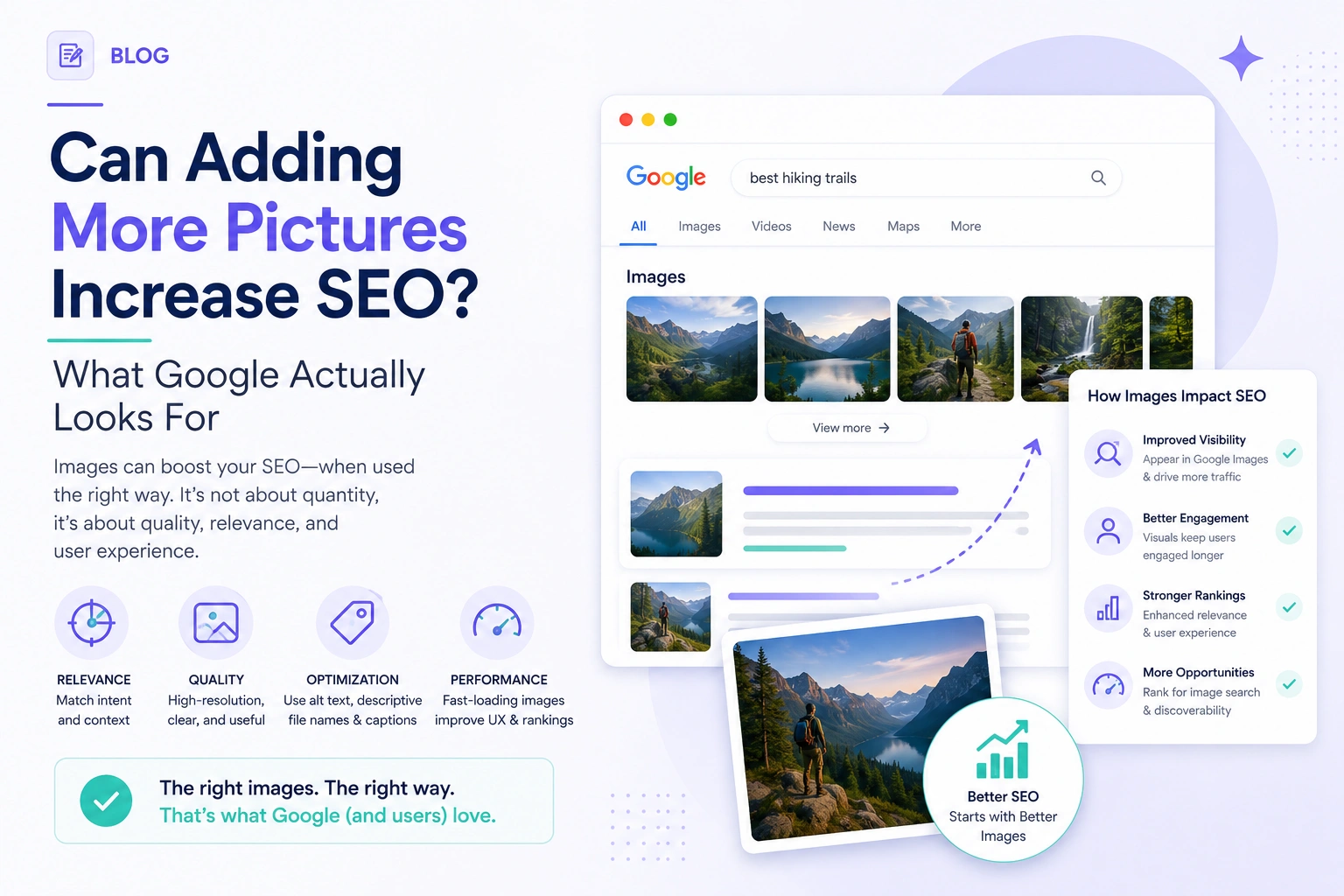
When images are used correctly, they can improve readability, increase engagement, strengthen semantic relevance, and even generate additional organic traffic through Google Image Search. But when images are poorly optimized, irrelevant, or excessive, they can slow down a website and negatively impact user experience.
Modern SEO is about balance.
And visual content plays a much bigger role in that balance than most people realize.
Does Adding More Images Directly Improve SEO?
The short answer is no.
Google does not automatically rank a webpage higher simply because it contains more pictures. Uploading twenty stock photos into a blog post does not send a “better SEO” signal to search engines.
What matters is how those images contribute to the quality of the content experience.
Search engines increasingly analyze whether a page satisfies user intent effectively. Images can support that process when they make content easier to understand, improve readability, or provide additional context that helps users engage more deeply with the topic.
For example, an article explaining technical SEO concepts becomes significantly more useful when it includes screenshots, diagrams, optimization examples, analytics visuals, or structured workflows. Those visuals help users understand complex ideas faster than text alone.
On the other hand, generic stock photos of people sitting in meetings usually add little actual value to the page. They may make the design look cleaner, but they rarely improve topical relevance or user understanding.
This is why modern SEO image optimization focuses less on image quantity and more on image usefulness.
Google’s systems are becoming increasingly effective at evaluating whether content genuinely helps users. That includes visual content.
So while pictures themselves are not direct ranking factors in the traditional sense, they can strongly influence the engagement and usability signals that support long-term SEO performance.
Why Images Improve User Experience and Engagement
One of the biggest reasons images help SEO indirectly is because they improve how people interact with content.
Most users do not read webpages word-for-word immediately after landing on them. Instead, they scan pages quickly to decide whether the information feels useful, trustworthy, and easy to consume.
When users encounter large blocks of uninterrupted text, especially on mobile devices, the content often feels overwhelming. Many visitors leave before fully engaging with the page.
Strategic visual content helps solve that problem.
Images create breathing room within content. They make articles feel more approachable and easier to navigate. They also help maintain attention, especially in long-form educational content where readers may otherwise lose focus.
This matters because user engagement signals increasingly influence SEO performance.
When visitors stay on a page longer, scroll deeper, interact more naturally, and continue exploring a website, search engines may interpret those behaviors as indicators of content quality.
For example, imagine two blog posts covering the same SEO topic.
The first article contains long paragraphs with no formatting, no visuals, and no supporting examples. Even if the information is technically accurate, the reading experience feels exhausting.
The second article includes relevant screenshots, visual examples, charts, diagrams, and optimized formatting that supports readability.
Most users will naturally prefer the second experience.
That preference often translates into stronger engagement metrics, lower bounce rates, improved dwell time, and better overall user satisfaction — all of which contribute indirectly to stronger search visibility.
This is why modern content optimization is closely connected to user experience design.
SEO today is no longer just about helping search engines understand a page. It is equally about helping real people consume information comfortably.
The Difference Between Helpful Images and Meaningless Images
Not every image improves SEO.
In fact, adding too many low-quality or irrelevant images can actually hurt website performance if they slow down loading speed or distract users from the main content.
This is one of the biggest misconceptions surrounding visual SEO.
Many websites still add images simply to “fill space” or make pages appear more visually complete. But Google increasingly evaluates whether content elements provide actual value.
Helpful images are usually connected directly to the topic being discussed. They support understanding, clarify concepts, demonstrate examples, or strengthen contextual relevance.
For example, an article about local SEO benefits from screenshots of Google Business Profiles, ranking dashboards, local search examples, and optimization workflows.
An article about technical SEO becomes more useful when it includes crawl diagrams, indexing reports, Core Web Vitals examples, or structured data screenshots.
These visuals contribute to user understanding.
That is very different from generic stock photography that exists only for decoration.
Modern search engines are becoming increasingly sophisticated at identifying the difference between genuinely helpful visual content and meaningless filler.
This is why businesses should focus on image relevance rather than image volume.
A page with five highly useful visuals often performs far better than a page overloaded with random stock photos.
How Image SEO Works in Modern Search
Many website owners still underestimate how advanced image SEO has become.
Search engines now analyze images using multiple contextual and technical signals. They attempt to understand what an image represents, how it connects to surrounding content, and whether it improves the overall page experience.
This includes evaluating image file names, surrounding text, image alt text, page relevance, structured data, loading speed, and mobile optimization.
For example, a file named:
technical-seo-audit-dashboard.webp
…provides far more contextual relevance than a generic file name like:
IMG00392.jpg
Similarly, properly written alt text helps search engines understand image meaning while also improving accessibility for users relying on screen readers.
Good alt text describes the image naturally and contextually.
For example:
“SEO audit dashboard showing indexing errors and page performance metrics.”
That description provides clear meaning.
By comparison, keyword-stuffed or vague alt text provides little value and may even appear manipulative.
This is why modern technical SEO increasingly overlaps with accessibility and user-focused optimization practices.
Search engines reward websites that organize information clearly and make content easier for both humans and machines to understand.
Can Images Increase Organic Traffic?
Yes — especially through Google Image Search.
This is one of the most overlooked traffic opportunities in modern SEO.
Many businesses focus entirely on traditional search rankings while ignoring how much visibility optimized visuals can generate independently.
Original images, infographics, charts, screenshots, and educational graphics can all rank in Google Image Search and attract highly relevant traffic.
This is especially valuable for industries like:
- ecommerce
- digital marketing
- SaaS
- web design
- local businesses
- healthcare
- education
- home improvement
For example, a marketing agency publishing custom SEO diagrams and analytics examples may attract additional visitors searching specifically for visual SEO resources.
Over time, those visual assets strengthen overall topical authority and improve broader search visibility.
This is why many advanced SEO strategies now include dedicated visual content planning instead of treating images as an afterthought.
Why Page Speed Matters More Than Adding More Pictures
One of the biggest mistakes websites make is uploading large, uncompressed images that slow down the page significantly.
Page speed is now a major part of modern SEO and user experience optimization.
Even high-quality content can struggle if a website loads slowly, especially on mobile devices.
Large image files often hurt:
- page performance
- mobile usability
- Core Web Vitals
- user engagement
- overall page experience
This is why image optimization matters far more than image quantity.
Modern websites should compress images properly, use responsive formats, optimize dimensions, and prioritize fast-loading visual experiences.
A fast page with a few highly relevant optimized visuals usually performs much better than a slow page overloaded with oversized images.
Search engines increasingly prioritize usability and accessibility, particularly for mobile-first indexing environments.
That means visual optimization must always support performance — not damage it.
Why Original Images Perform Better Than Generic Stock Photography
Original visual content usually provides stronger SEO value than generic stock photos.
That is because original visuals help establish uniqueness, credibility, and topical relevance.
For example, custom:
- screenshots
- charts
- process diagrams
- branded graphics
- comparison visuals
- analytics examples
…all contribute to a more authentic content experience.
This matters because many industries now suffer from content saturation. Thousands of websites publish nearly identical articles covering the same topics.
Original visuals help differentiate content.
They also strengthen trust because users can immediately recognize when a website demonstrates real experience instead of relying on generic visuals copied from stock image libraries.
Google increasingly rewards unique and experience-driven content experiences, especially in competitive niches where originality matters.
This aligns closely with broader EEAT principles focused on expertise, authority, and trustworthiness.
So, Can Adding More Pictures Increase SEO?
The honest answer is:
Sometimes — but only when those pictures genuinely improve the content experience.
Images can absolutely support SEO when they:
- improve user experience
- strengthen semantic relevance
- increase engagement
- support accessibility
- improve readability
- help explain concepts visually
- attract image search traffic
But simply adding more pictures without strategy usually does very little.
In some cases, it can even hurt performance if page speed suffers.
Modern SEO is less about “adding more” and more about creating better user experiences.
That includes visual experiences.
The websites performing best in 2026 are not stuffing pages with random images.
They are using visual content strategically to create more useful, engaging, and trustworthy content for real people.
Frequently Asked Questions
1. Do more images improve Google rankings?
Not automatically. Images help SEO indirectly when they improve user experience, engagement, accessibility, and content quality.
2. What is image SEO?
Image SEO is the process of optimizing images for search engines using proper file names, alt text, compression, structured data, and contextual relevance.
3. Can images increase organic traffic?
Yes. Optimized visuals can attract traffic through Google Image Search and improve overall engagement signals.
4. Does image alt text matter for SEO?
Yes. Alt text helps search engines understand image context while also improving accessibility.
5. Can too many images hurt SEO?
Yes. Large or poorly optimized images can slow page speed and negatively impact user experience and technical SEO performance.
Want better rankings without relying on outdated SEO tricks?
Modern SEO success comes from creating high-quality user experiences — and strategic visual content is part of that process.