
Search is changing faster than most businesses expected.
For years, SEO strategies focused almost entirely on rankings inside traditional search engines. Businesses tracked keyword positions, backlinks, organic traffic, technical SEO scores, and click-through rates because those metrics directly influenced online visibility.
If a company ranked on the first page of Google Google, the strategy was considered successful.
But search behavior is no longer limited to traditional search results.
Today, users increasingly rely on AI-powered search experiences to discover businesses, compare services, and make buying decisions. Instead of manually browsing multiple websites, people now ask conversational questions through platforms like OpenAI ChatGPT, Google Gemini, and Perplexity AI Perplexity.
Questions like:
“What’s the best SEO agency for SaaS companies?”
“Which digital marketing tools improve local SEO?”
“What are the top AI SEO optimization platforms in 2026?”
…are increasingly answered directly by AI systems.
That shift is transforming how businesses compete for online visibility.
Modern SEO is no longer just about ranking webpages. It is also about becoming a trusted source that AI systems recognize, understand, and recommend confidently.
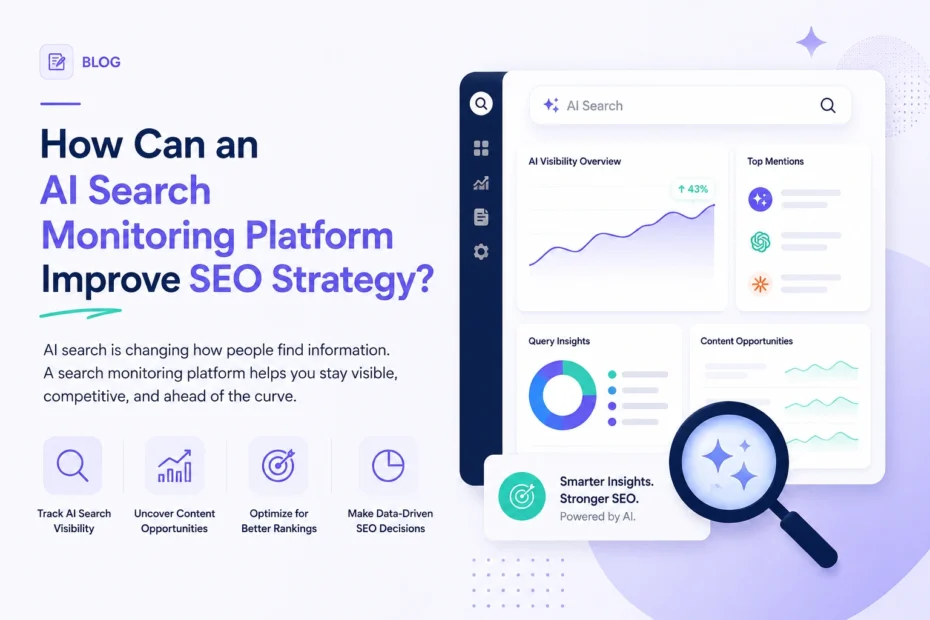
This is exactly why AI search monitoring platforms are becoming one of the most valuable tools in modern SEO strategy.
These platforms help businesses understand how AI systems interpret their brand, where they appear in AI-generated search experiences, how competitors gain visibility, and what improvements are needed to strengthen long-term search performance.
In many ways, AI search monitoring is becoming the next evolution of SEO analytics.
What Is an AI Search Monitoring Platform?
An AI search monitoring platform is a tool designed to track and analyze how brands appear across AI-driven search environments.
Traditional SEO software mainly measures search engine rankings, backlinks, crawlability, indexing performance, and organic traffic trends. Those metrics still matter because technical SEO and search visibility remain foundational parts of digital marketing.
However, AI-powered search introduces a new layer of discoverability that traditional SEO tools often cannot measure effectively.
Modern AI search monitoring tools analyze how large language models and AI systems interpret your business online. They monitor factors such as AI-generated brand mentions, topical authority, semantic relevance, entity recognition, trust signals, and visibility inside conversational search experiences.
This matters because users are interacting with search differently than before.
When someone asks an AI assistant for recommendations, the system may summarize information from multiple trusted sources instead of simply displaying a list of search results. That means businesses now compete not only for rankings, but also for inclusion inside AI-generated answers.
An AI search monitoring platform helps businesses understand whether AI systems view their content as authoritative enough to reference confidently.
Without this type of monitoring, companies may have strong traditional rankings while remaining almost invisible inside AI-driven search experiences.
That visibility gap is becoming increasingly important in 2026.
Why Traditional SEO Tracking Is No Longer Enough
Traditional SEO reporting still provides valuable insights, but it no longer reflects the entire search landscape.
For years, SEO campaigns focused heavily on ranking positions and traffic growth. Businesses wanted to know which keywords ranked on page one, how many visitors arrived from organic search, and which pages generated the most clicks.
Those metrics are still useful.
But modern search behavior is changing rapidly because AI systems increasingly provide direct answers before users even visit websites.
This creates a major shift in how visibility works online.
A business may technically rank well in traditional search results while losing exposure inside AI-generated recommendations. In some cases, users may never click through to a website because the AI system already summarized the information they needed.
That means SEO success can no longer be measured only through rankings alone.
Businesses also need visibility inside:
- conversational search systems
- AI-generated recommendations
- AI answer engines
- generative search experiences
- AI-assisted product discovery
This is where AI search visibility monitoring becomes critical.
For example, imagine two digital marketing agencies operating in the same industry.
Both agencies rank similarly in organic search results. However, one agency has stronger semantic SEO, more educational content, clearer expertise signals, consistent brand mentions, and stronger topical authority across multiple platforms.
The second agency mainly focuses on backlinks and exact-match keyword targeting.
Even if both perform similarly in traditional rankings, AI systems are far more likely to recommend the first agency because its expertise and authority are easier to interpret contextually.
That difference matters enormously in modern SEO.
Businesses now need to understand not only where they rank, but also how AI systems perceive their authority, expertise, and trustworthiness online.
How an AI Search Monitoring Platform Improves SEO Strategy
One of the biggest advantages of an AI search monitoring platform is that it gives businesses a much deeper understanding of their digital visibility.
Traditional SEO tools mainly tell you whether pages rank.
AI monitoring tools help explain why certain brands become trusted answers inside AI-powered search systems.
This changes SEO strategy completely.
Instead of focusing only on keywords and rankings, businesses can analyze:
- how often their brand appears in AI-generated responses
- which topics AI systems associate with the brand
- where competitors dominate AI visibility
- which content areas lack topical depth
- how semantic relevance impacts discoverability
- whether authority signals are strong enough
These insights help businesses make smarter SEO decisions.
For example, an AI monitoring platform may reveal that competitors consistently appear in AI-generated recommendations related to “local SEO for law firms” while your website rarely appears in those conversations.
That insight immediately exposes a topical authority gap.
Instead of randomly publishing more blog content, your SEO strategy becomes more focused. You can build highly relevant content clusters, improve semantic relevance, strengthen expertise signals, and create more comprehensive resources around that topic.
This creates a much more intelligent and sustainable SEO strategy.
Modern search optimization is no longer about producing the highest volume of content. It is about creating the most trustworthy and contextually relevant content ecosystem possible.
The Growing Importance of Semantic SEO in AI Search
One of the biggest reasons AI search monitoring matters is because modern AI systems rely heavily on semantic SEO.
A few years ago, many websites ranked successfully by repeating exact-match keywords throughout pages. That strategy worked because older algorithms relied more heavily on keyword frequency signals.
Today, search engines and AI systems understand language much more contextually.
They evaluate:
- topic relationships
- contextual relevance
- expertise depth
- user intent
- semantic connections
- authority signals
That means businesses need broader topical coverage instead of isolated keyword targeting.
An AI search monitoring platform helps identify where semantic gaps exist within your content strategy.
For example, a website targeting “technical SEO services” may rank for that phrase but still lack contextual coverage related to:
- crawl optimization
- indexing
- structured data
- Core Web Vitals
- AI search visibility
- semantic architecture
- entity optimization
AI systems notice those gaps.
Without broader semantic depth, businesses may struggle to establish strong topical authority.
This is why modern SEO strategies increasingly focus on building connected content ecosystems rather than standalone keyword pages.
AI monitoring platforms help businesses understand whether their content ecosystem actually demonstrates expertise from a semantic perspective.
That insight is incredibly valuable for long-term organic growth.
How AI Search Monitoring Improves Content Strategy
Many businesses still create content primarily based on keyword search volume.
That approach is becoming less effective because modern search systems prioritize usefulness, contextual depth, and user satisfaction much more heavily than before.
An AI search monitoring platform helps businesses understand:
- what users are asking AI systems
- which topics generate visibility
- where content gaps exist
- what themes competitors dominate
- which content formats build authority
- how search intent is evolving
This changes content strategy from reactive publishing into strategic authority building.
Instead of producing generic SEO articles designed only to rank temporarily, businesses can focus on creating:
- expert-led educational content
- in-depth guides
- semantic topic clusters
- original research
- thought leadership resources
- AI-friendly content structures
This type of content performs better not only in traditional search engines, but also in AI-generated search environments where authority and usefulness matter more than keyword density.
In many ways, AI-driven search is pushing SEO back toward what it should have been all along: creating genuinely valuable information for real users.
Why Competitive AI Visibility Matters in Modern SEO
SEO competition is evolving rapidly because businesses now compete for AI-generated visibility as well as traditional rankings.
An AI search monitoring platform helps businesses understand:
- which competitors dominate AI-generated answers
- what authority signals competitors have built
- how competitors structure content
- which entities AI systems associate with competitors
- where content opportunities exist
This provides much deeper competitive insight than traditional SEO reporting alone.
For example, a SaaS company may discover that competitors appear frequently in AI-generated comparisons because their content includes stronger educational resources, clearer positioning, and better semantic topic coverage.
That insight allows businesses to refine strategy based on actual AI visibility data instead of assumptions.
This is becoming especially important in highly competitive industries like:
- SaaS
- healthcare
- legal services
- finance
- digital marketing
- ecommerce
- local business SEO
The businesses adapting fastest to AI-driven search behavior may gain a significant long-term advantage over competitors still relying only on traditional SEO metrics.
Can AI Search Monitoring Improve Organic Traffic and Leads?
Indirectly, yes.
An AI search monitoring platform does not instantly generate leads or rankings by itself. However, it helps businesses improve the underlying factors that influence visibility, authority, and trust.
Businesses with stronger AI search visibility often experience:
- increased branded searches
- stronger engagement signals
- improved click-through rates
- higher trust perception
- better lead quality
- more qualified traffic
This happens because users repeatedly encounter the brand across multiple search touchpoints.
When businesses appear consistently in:
- Google rankings
- AI-generated recommendations
- educational content hubs
- trusted citations
- conversational search results
…they naturally build stronger credibility in the minds of potential customers.
That credibility becomes incredibly valuable during the buying process, especially for high-trust industries where expertise strongly influences purchasing decisions.
The Future of SEO Strategy Is AI-Aware
SEO is not disappearing.
But it is evolving faster than many businesses expected.
The future of SEO strategy will depend heavily on understanding how AI systems discover, evaluate, interpret, and recommend information online.
That means modern SEO strategies must combine:
- technical SEO
- semantic SEO
- topical authority
- AI search visibility
- content marketing
- entity optimization
- user experience
- conversion optimization
An AI search monitoring platform helps businesses track all of these signals more effectively.
Most importantly, it helps companies adapt to how search behavior is changing in real time.
And in 2026, adaptability may become one of the most valuable SEO advantages a business can have.
Ready to Strengthen Your AI Search Visibility?
As AI-powered search continues to reshape how customers discover businesses online, having the right SEO strategy is more important than ever. At Webomedia Technology, we help businesses build stronger search visibility through advanced SEO, semantic content strategies, AI-focused optimization, and data-driven digital marketing solutions.
Whether you want to improve organic rankings, increase qualified traffic, or position your brand for the future of AI-driven search, our experts are here to help.
Get in touch with Webomedia Technology today and discover how a smarter SEO strategy can help your business grow faster, rank higher, and stay ahead of the competition.