Why Semantic SEO Matters More Than Ever
A few years ago, SEO was much simpler than it is today.
Many websites managed to rank well simply by repeating exact-match keywords throughout a page. If someone wanted to rank for a phrase like “best SEO agency,” they would place that keyword in headings, paragraphs, image alt text, and metadata as many times as possible. In some cases, that strategy actually worked.
But search engines and AI systems have evolved far beyond that approach.
Modern search algorithms now focus heavily on understanding meaning, context, and user intent rather than counting how many times a keyword appears on a page. This shift is one of the biggest reasons semantic SEO has become such an important part of modern optimization strategies.
Today, AI-driven search systems like Google AI Overviews, OpenAI ChatGPT, and Perplexity AI Perplexity attempt to understand whether content genuinely answers a user’s question in a meaningful way.
For example, if someone searches:
“Can agencies use LLM audits for SEO?”
AI systems are not simply checking whether the phrase appears repeatedly across the article.
Instead, they evaluate whether the content fully explains the topic from multiple angles.
They want to understand:
- What LLM SEO audits actually are
- Why agencies are using them
- How AI SEO optimization works
- The relationship between semantic SEO and AI-driven search
- The benefits for local businesses and SaaS brands
- Technical SEO implications
- Real-world applications
- Potential limitations and risks
This is exactly where semantic SEO becomes powerful.
Instead of building shallow keyword-focused pages, agencies are now creating comprehensive content ecosystems designed around topics, user intent, and expertise.
A strong content ecosystem naturally includes related concepts such as:
- Technical SEO audits
- AI search visibility
- Google AI Overviews SEO
- Entity SEO
- AI citation tracking
- Local SEO optimization
- Content marketing strategies
- Conversion optimization
- Organic traffic growth
- User experience improvements
When all of these topics connect naturally within a website, search engines gain stronger confidence that the business genuinely understands the subject matter.
That confidence matters because AI systems increasingly prioritize topical authority over isolated keyword optimization.
This is also why many businesses are seeing declining results from outdated SEO tactics. Thin content written purely for algorithms often struggles because it lacks depth, clarity, and real value for users.
Meanwhile, websites that publish genuinely useful, experience-driven content are building stronger long-term visibility across both traditional search engines and AI-powered search experiences.
In many ways, semantic SEO is simply a more intelligent and human-focused version of SEO.
Instead of asking:
“How many times should we use this keyword?”
Modern agencies ask:
“Does this content fully solve the user’s problem?”
That mindset shift is shaping the future of SEO in 2026.
How LLM Audits Help Agencies Improve AI Search Visibility
One of the biggest reasons agencies are investing in LLM SEO audits is because AI-generated search visibility is becoming increasingly valuable for businesses.
Today, people do not always browse multiple websites before making decisions. Many users now rely on AI systems to summarize information, recommend businesses, compare services, and answer questions directly.
For example, someone might ask an AI assistant:
- Which SEO agencies specialize in SaaS marketing?
- What are the best local SEO companies for dentists?
- Which agencies are trusted for AI SEO optimization?
In many cases, the AI system generates direct recommendations instead of simply displaying search results.
That creates a completely new type of competition for online visibility.
Businesses are no longer competing only for rankings. They are competing to become trusted sources that AI systems feel confident referencing.
This is where a professional LLM SEO audit becomes incredibly useful.
An audit helps agencies understand how AI systems interpret a business online. It identifies weaknesses that may reduce visibility inside AI-generated search experiences.
For example, agencies often discover problems such as:
- Weak topical authority
- Unclear service descriptions
- Poor content structure
- Inconsistent brand messaging
- Missing entity relationships
- Weak trust signals
- Technical SEO limitations
- Thin educational content
Sometimes the problem is not rankings at all.
A website may technically rank well in traditional search results while still struggling to appear inside AI-generated answers because AI systems cannot confidently interpret the brand’s expertise.
That distinction is important.
AI systems rely heavily on clarity, structure, consistency, and semantic understanding. If a business lacks those signals, visibility opportunities may disappear even when traditional SEO metrics appear healthy.
This is why many agencies now treat AI search visibility as an extension of modern SEO rather than a separate marketing channel.
The goal is no longer just attracting clicks.
The goal is becoming a trusted digital authority across search engines, AI systems, and conversational search platforms.
The Connection Between Technical SEO and LLM Optimization
Some marketers mistakenly assume that AI optimization replaces technical SEO.
That is completely incorrect.
In reality, technical SEO is becoming even more important because AI systems still rely on well-structured, accessible, and properly organized websites.
Even the best content can struggle if the technical foundation is weak.
For example, AI systems may have difficulty processing a website effectively if:
- Pages load slowly
- Mobile usability is poor
- Structured data is missing
- Internal linking is weak
- Important pages are inaccessible
- Crawlers cannot properly index content
- Site architecture is confusing
This is why a strong technical SEO audit remains essential in modern SEO strategies.
Think of technical SEO as the infrastructure that supports search visibility.
Without that infrastructure, even highly authoritative content may fail to perform effectively across both traditional search engines and AI-powered platforms.
Modern agencies understand that successful optimization requires combining multiple disciplines together.
That includes:
- Technical SEO
- Semantic SEO
- Content marketing
- Entity optimization
- User experience
- Conversion optimization
- AI visibility analysis
- Search intent optimization
The agencies producing the best long-term results are integrating all of these elements into one cohesive strategy rather than treating them as separate tasks.
This integrated approach is becoming increasingly important because AI systems evaluate websites holistically.
They do not only assess keywords or backlinks.They evaluate overall quality, trustworthiness, expertise, accessibility, structure, and usefulness.
That is why technical SEO still plays a foundational role in AI-driven search optimization.
Why Local SEO Agencies Should Pay Attention to LLM Audits
Local SEO is changing rapidly because AI-generated recommendations are becoming more common in local search experiences.
Today, users often ask conversational local questions such as:
“What’s the best digital marketing agency near me for home service businesses?”
Instead of displaying only a map pack or directory listings, AI systems may now generate direct recommendations based on multiple trust and relevance signals.
These systems pull information from sources like:
- Google Business Profiles
- Reviews
- Local citations
- Website content
- Industry mentions
- Customer sentiment
- Geographic relevance
- Topical authority
That means local businesses need more than basic local SEO optimization.
They need strong digital authority signals that AI systems can interpret confidently.
This is why local SEO agencies are beginning to combine traditional local optimization with broader AI SEO optimization strategies.
For example, agencies are increasingly focusing on:
- Google Business Profile optimization
- Local entity SEO
- Hyperlocal content creation
- Consistent business information
- Review quality management
- Geographic relevance
- Community authority signals
- Local trust-building content
Businesses that appear credible, authoritative, and consistent across the web are more likely to gain visibility inside AI-generated local recommendations.
This matters because local buying decisions often happen quickly.
If an AI system confidently recommends one business over another, that recommendation may strongly influence user behavior.
For local agencies, this creates both a challenge and an opportunity.
The agencies adapting early to AI-driven local search may gain a significant competitive advantage over businesses still relying only on traditional ranking strategies.
Can LLM Audits Improve Organic Traffic and Lead Generation?
An LLM SEO audit does not magically generate leads overnight.
But it can absolutely improve the factors that contribute to long-term lead generation and organic growth.
The biggest benefit is improved visibility and trust.
Businesses with strong AI search visibility are more likely to appear across multiple customer touchpoints, including:
- Traditional Google rankings
- AI-generated recommendations
- Conversational search results
- Industry discussions
- Knowledge summaries
- Trusted citations
That repeated exposure matters psychologically.
When users encounter the same business repeatedly across trusted platforms, they naturally begin viewing the brand as more authoritative and reliable.
This often leads to:
- Increased branded searches
- Better click-through rates
- Higher engagement
- Stronger conversion rates
- More qualified traffic
- Better lead quality
The trust factor becomes especially important for high-value services such as:
- SEO agencies
- SaaS companies
- Law firms
- Healthcare providers
- Financial services
- B2B consulting firms
In these industries, customers rarely buy immediately after seeing a single advertisement or webpage.
They research, compare, validate, and seek reassurance before making decisions.
Strong semantic SEO, authoritative content, and AI visibility help reinforce trust throughout that process.
This is why many agencies now view LLM optimization services as part of broader digital authority building rather than isolated SEO tactics.
The Biggest Mistakes Agencies Make With AI SEO Optimization
As interest in AI-driven search grows, many agencies are rushing into AI SEO optimization without fully understanding how it works.
Unfortunately, that often leads to low-quality strategies.
Some agencies focus too heavily on automation and shortcuts instead of expertise and usefulness.
That approach rarely performs well long term.
Modern AI systems are becoming increasingly effective at identifying shallow, manipulative, or low-value content.
Some of the most common mistakes agencies make include:
- Publishing generic AI-generated articles with little original insight
- Overusing keywords unnaturally
- Creating thin content purely for rankings
- Ignoring user intent
- Producing repetitive topic pages
- Prioritizing quantity over quality
- Making misleading authority claims
- Neglecting technical SEO foundations
These tactics may create temporary visibility spikes, but they usually fail to build lasting trust or authority.
The agencies succeeding with AI SEO optimization are doing the opposite.
They focus on:
- Expert-led content
- Original insights
- Helpful educational resources
- Clear semantic structure
- Strong topical authority
- Trustworthy branding
- User-focused experiences
In other words, the agencies winning in AI search are the ones behaving more like publishers, consultants, and educators rather than keyword-focused SEO vendors.
What Smart Agencies Are Doing Differently in 2026
The most successful agencies in 2026 are approaching SEO very differently from traditional agencies.
They are no longer asking:
“How do we rank this page?”
Instead, they ask:
“How do we become the most trusted answer online?”
That shift completely changes content strategy.
Modern agencies understand that future SEO success depends on becoming genuinely useful and authoritative within their niche.
As a result, they are investing heavily in:
- Research-driven content
- Original industry insights
- Topical authority building
- Semantic SEO
- Entity optimization
- Content experience
- User engagement
- AI citation readiness
- Brand trust development
These agencies understand something many businesses still overlook:
AI systems tend to favor businesses that consistently demonstrate expertise and trustworthiness across multiple digital channels.
This aligns closely with Google’s long-standing focus on EEAT principles:
- Experience
- Expertise
- Authoritativeness
- Trustworthiness
In many ways, AI-driven search is simply accelerating the importance of those principles.
The agencies adapting successfully are building brands people trust — not just websites optimized for algorithms.
The Future of SEO Agencies in an AI-First Search Landscape
The SEO industry is entering one of the biggest transitions it has experienced in years.
But this is not the death of SEO.
It is the evolution of SEO.
Businesses still need visibility. Customers still search for answers. Brands still compete for attention, trust, and conversions.
What is changing is how search happens.
Search behavior is becoming:
- More conversational
- More contextual
- More AI-assisted
- More intent-driven
That means agencies must evolve alongside it.
The future belongs to agencies that can successfully combine:
- Traditional SEO
- Semantic SEO
- Technical SEO
- AI-driven search optimization
- Content marketing
- User experience
- Brand authority
- Conversion strategy
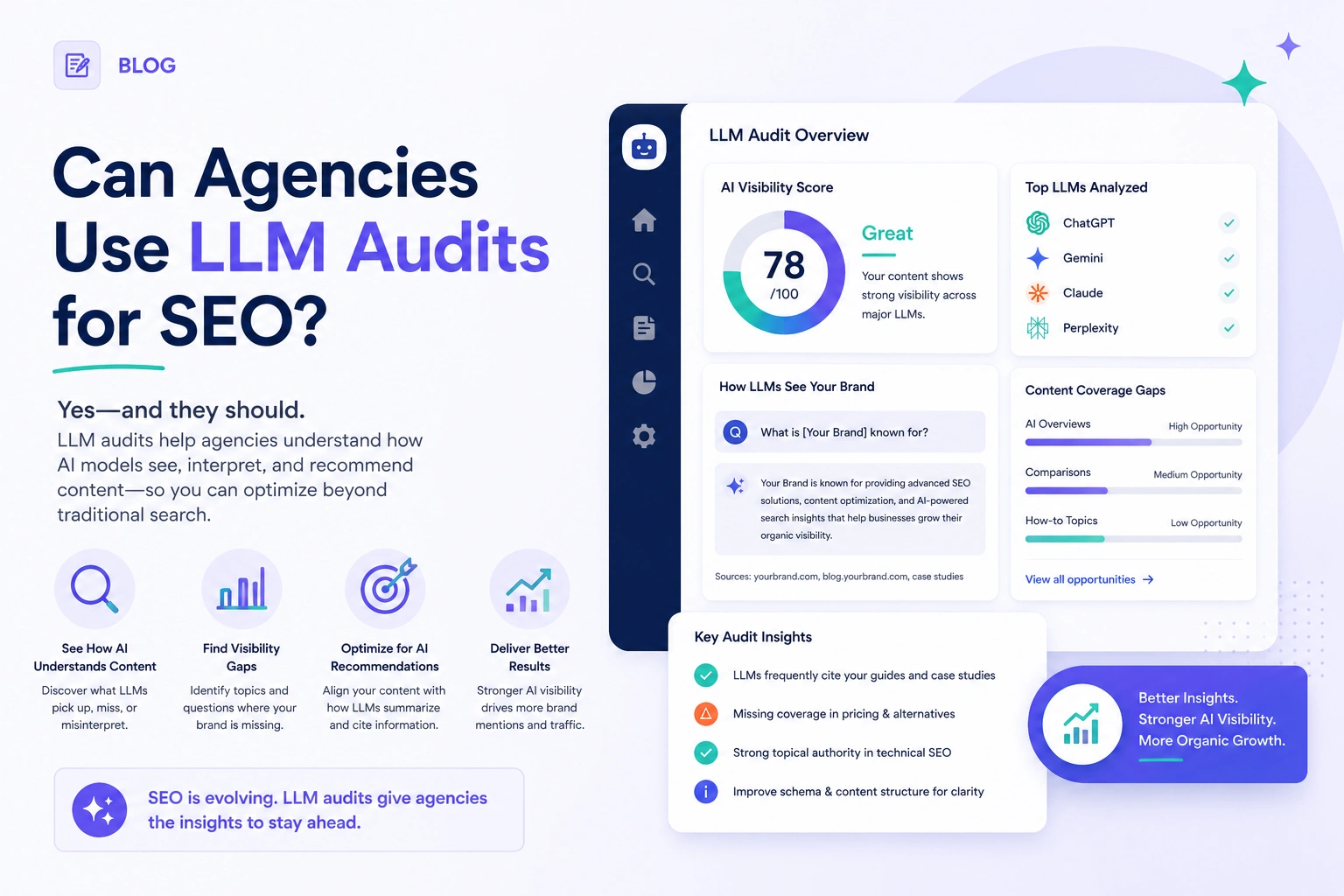
A modern LLM SEO audit helps agencies understand where they currently stand within this changing ecosystem.
More importantly, it helps them prepare for where search is heading next.
And right now, search is clearly moving toward a future where trust, authority, expertise, and usefulness matter more than ever before.
Frequently Asked Questions
1. What does an LLM SEO audit actually measure?
An LLM SEO audit evaluates how AI systems interpret your content, recognize your expertise, understand your brand entities, and potentially reference your business in AI-generated answers.
2. Is AI SEO optimization replacing traditional SEO?
No. Traditional SEO still matters heavily. AI optimization works alongside technical SEO, content marketing, and semantic optimization.
3. Why is semantic SEO important for AI search?
AI systems rely on contextual understanding rather than simple keyword matching. Semantic SEO helps establish topical relevance and authority.
4. Can local businesses benefit from LLM optimization?
Absolutely. Local businesses can improve AI visibility through strong local SEO signals, reviews, entity consistency, and authoritative content.
5. Do AI-generated answers affect organic traffic?
In some cases, yes. AI answers may reduce clicks for certain searches while increasing visibility opportunities for authoritative brands.
Conclusion
So, can agencies use LLM audits for SEO?
Without question.
In fact, agencies that ignore AI-driven search may eventually struggle to compete in a rapidly evolving digital landscape.
A modern LLM SEO audit helps businesses understand how AI systems perceive their authority, content quality, expertise, and online visibility.
But the bigger takeaway is this:
The future of SEO is becoming more human, not less.
Search engines and AI systems are increasingly rewarding content that demonstrates:
- Real expertise
- Genuine helpfulness
- Clear authority
- Strong user experience
- Semantic relevance
- Trustworthiness
That means agencies no longer win simply by gaming algorithms.
They win by becoming valuable, credible, and genuinely useful resources for users.
And in many ways, that’s exactly how SEO should work moving forward.
If your agency wants to stay competitive in the era of AI-powered search, now is the time to invest in smarter SEO strategies.