
Introduction
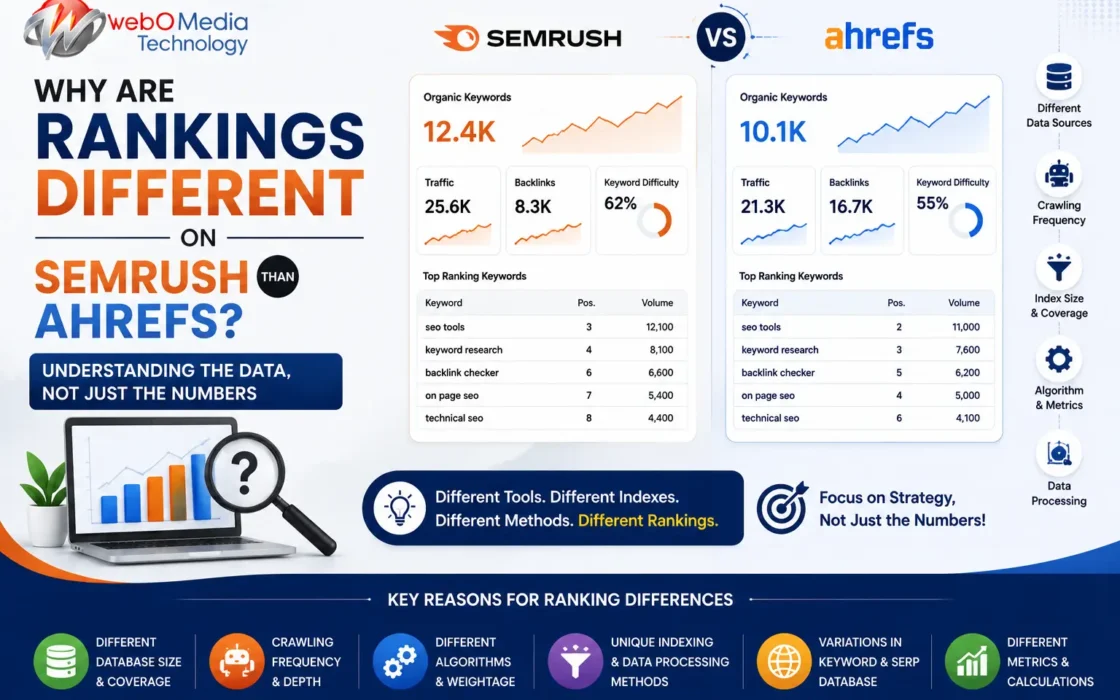
If you’ve ever compared your keyword rankings in Semrush and Ahrefs, you’ve probably noticed that they don’t always match. One tool might report your website ranking in position #3 for a keyword, while another shows it at #7—or doesn’t show the keyword ranking at all. This often leaves business owners, marketers, and SEO professionals wondering: Why are rankings different on Semrush than Ahrefs?
The short answer is that neither tool is wrong. Both Semrush and Ahrefs collect search engine data using their own databases, algorithms, crawlers, update schedules, and keyword tracking methodologies. Since Google personalizes search results and updates its index continuously, no third-party SEO tool can display exactly the same rankings that every user sees.
Understanding how these platforms gather and interpret ranking data is essential for making informed SEO decisions. Instead of assuming one tool is more accurate than the other, it’s important to understand why Semrush and Ahrefs show different rankings, what factors influence their reports, and how to use each platform effectively.
In this guide, we’ll explain the reasons behind these differences, compare their keyword tracking methods, discuss Semrush vs Ahrefs rankings, and share practical tips for monitoring your website’s search performance more accurately.
Why SEO Tools Rarely Show the Same Rankings
Many people expect SEO tools to provide identical ranking reports because they all measure the same search engine—Google. However, Google processes billions of searches every day, and the results shown to users vary depending on multiple factors such as location, device, language, browsing history, and search intent.
SEO platforms cannot access Google’s complete ranking database. Instead, they collect data independently using their own crawlers, keyword databases, and tracking systems. Each company decides which keywords to monitor, how frequently to update rankings, and how to interpret search engine results. As a result, it’s perfectly normal for keyword rankings in Semrush vs Ahrefs to differ.
Rather than focusing on small ranking differences, SEO professionals use these tools to identify trends, monitor progress, and uncover optimization opportunities.
How Semrush Collects Ranking Data
Semrush uses a large database of tracked keywords across numerous countries and search engines. Its ranking data is collected by regularly crawling Google’s search results and recording where websites appear for specific keywords. The platform also allows users to create custom Position Tracking campaigns that monitor selected keywords based on a chosen location, device type, and search engine.
Several factors influence Semrush ranking accuracy, including:
- Location selected for tracking
- Desktop vs. mobile search results
- Daily ranking updates (for Position Tracking)
- Size and freshness of the keyword database
- Search personalization excluded from tracked results
Because Semrush relies on standardized tracking conditions rather than personalized searches, the rankings displayed in the platform may differ from what individual users see when searching on Google.
How Ahrefs Tracks Keyword Rankings
Ahrefs follows a similar approach but uses its own proprietary crawler, keyword database, and ranking algorithms. Like Semrush, it gathers data from Google’s search results and provides keyword tracking based on selected locations and devices. However, Ahrefs may crawldifferent keywords at different times and apply slightly different methods when processing ranking data.
The accuracy of Ahrefs ranking reports depends on several factors, including:
- Keyword tracking frequency
- Selected search location
- Device-specific rankings
- Database updates
- SERP feature detection
- Historical data processing
Since Ahrefs maintains an independent database, it’s common to see variations when comparing keyword rankings between the two platforms.
Semrush vs Ahrefs Rankings: Why They Don’t Match
One of the most common questions among SEO professionals is why the same keyword can show different positions in Semrush and Ahrefs. The explanation lies in how each platform collects and processes data rather than in the accuracy of either tool.
Several factors contribute to these differences:
1. Different Keyword Databases
Each platform maintains its own database of keywords, which means one tool may track keywords that the other updates less frequently. The size, freshness, and geographic coverage of these databases also vary.
2. Different Crawling Schedules
Google’s search results change continuously. If Semrush checks a keyword in the morning and Ahrefs updates it later in the evening, both tools may capture different ranking positions.
3. Geographic Differences
Google displays different results depending on the user’s location. If one platform tracks rankings from New York while another uses Chicago or London, ranking positions can change significantly.
Always ensure that both tools are configured for the same country, city, and language before comparing reports.
4. Mobile vs Desktop Rankings
Google often displays different search results on mobile and desktop devices. If Semrush tracks desktop rankings while Ahrefs tracks mobile rankings, the reported positions may not match.
5. SERP Features Affect Ranking Positions
Modern Google search results include:
- Featured Snippets
- AI Overviews (where available)
- Local Packs
- Shopping Results
- Videos
- People Also Ask
- Images
Some SEO tools count these features differently when calculating ranking positions, which can shift reported rankings even if the organic listing hasn’t changed.
6. Database Update Frequency
Every SEO platform refreshes its databases on different schedules. While both Semrush and Ahrefs update frequently, they don’t always update the same keywords at exactly the same time.
This timing difference alone can explain many apparent ranking discrepancies.
Google Rankings vs Semrush: Why Your Manual Search Looks Different
Another common source of confusion occurs when people compare Google search results with rankings shown inside Semrush or Ahrefs.
For example, you may search for your target keyword and see your website ranking in position #2, while Semrush reports position #5.
This happens because Google personalizes search results using factors such as:
- Search history
- Browser cookies
- Logged-in Google account
- Device type
- Language preferences
- Geographic location
- Search behavior
SEO tools intentionally remove most of these personalization signals to provide standardized ranking data that can be compared consistently over time.
As a result, Google rankings vs Semrush comparisons rarely match exactly—and that’s expected.
Which Tool Is More Accurate: Semrush or Ahrefs?
This question doesn’t have a simple yes-or-no answer because both tools are highly respected in the SEO industry and are designed for slightly different strengths. Rather than asking which platform is universally more accurate, it’s more useful to ask which tool is better suited to your specific SEO goals.
| Feature | Semrush | Ahrefs |
|---|---|---|
| Position Tracking | Excellent | Excellent |
| Keyword Research | Excellent | Excellent |
| Backlink Analysis | Very Good | Excellent |
| Technical SEO Audits | Excellent | Good |
| Competitor Analysis | Excellent | Very Good |
| Content Marketing Tools | Excellent | Good |
| Rank Tracking Flexibility | Excellent | Very Good |
Both platforms are capable of providing reliable insights when configured correctly. The key is to use one tool consistently rather than switching between platforms and comparing minor ranking differences every day.
Best Practices for Comparing Keyword Rankings
If you’re comparing Semrush vs Ahrefs rankings, make sure both tools use identical tracking settings. Without matching configurations, even accurate data can appear inconsistent.
Before comparing reports, verify that both tools use:
- The same country
- The same city (if applicable)
- The same device type
- The same language
- The same search engine
- The same keyword list
- Similar tracking dates
Even after matching these settings, small differences are still normal due to the way each platform collects and processes ranking data.
Common Mistakes When Comparing Semrush and Ahrefs Rankings
Many businesses become concerned when they notice ranking differences between SEO tools, but in most cases, the issue isn’t the tool—it’s how the comparison is being made. Semrush and Ahrefs use different datasets, crawling schedules, and tracking methodologies, so expecting identical results can lead to incorrect conclusions. Instead of comparing isolated ranking positions, SEO professionals analyze long-term trends and overall search visibility.
Some of the most common mistakes include:
- Comparing rankings from different countries or cities
- Tracking desktop rankings in one tool and mobile rankings in another
- Using different keyword lists
- Comparing reports generated on different dates
- Ignoring Google algorithm updates
- Expecting SEO tools to match personalized Google search results
- Judging performance based on a single keyword instead of overall trends
- Switching between tools too frequently without maintaining consistent tracking
Avoiding these mistakes will help you interpret ranking reports more accurately and make better SEO decisions.
How Google Algorithm Updates Affect SEO Tool Rankings
Google makes thousands of changes to its search algorithms every year, including several broad core updates that can significantly impact search rankings. During these periods, keyword positions often fluctuate rapidly, and SEO tools may report different ranking changes depending on when their databases are refreshed.
For example, if Google rolls out a core update over several days, Semrush may capture the ranking changes before Ahrefs updates its database—or vice versa. This doesn’t necessarily mean one platform is more accurate than the other; it simply reflects differences in data collection schedules.
Whenever you notice major ranking fluctuations:
- Check whether Google has announced or completed a core update.
- Compare ranking trends over several days instead of one report.
- Monitor Google Search Console for confirmation.
- Focus on overall visibility rather than temporary position changes.
Patience is important during algorithm updates because rankings often stabilize after Google completes the rollout.
Why Google Search Console Should Be Your Primary Source
When comparing Google rankings vs Semrush or Ahrefs ranking accuracy, it’s important to remember that neither platform has direct access to Google’s complete ranking database. They estimate rankings using their own crawlers and keyword tracking systems.
Google Search Console (GSC), however, provides data directly from Google about how your website performs in search results. While it also has limitations—such as averaging positions across users and locations—it remains the most authoritative source for measuring your website’s organic search performance.
A practical approach is to use each tool for what it does best:
- Google Search Console – Track clicks, impressions, average position, and indexing status.
- Semrush – Keyword tracking, technical SEO audits, competitor analysis, and content research.
- Ahrefs – Backlink analysis, keyword research, competitor insights, and link opportunities.
Using these tools together provides a more complete understanding of your SEO performance than relying on any single platform.
Which SEO Tool Should You Choose?
Choosing between Semrush and Ahrefs depends on your business objectives, budget, and workflow. Both platforms are trusted by SEO professionals worldwide, but each has strengths that make it more suitable for certain tasks.
Choose Semrush if you need:
- Comprehensive technical SEO audits
- Advanced keyword research
- Position Tracking campaigns
- Local SEO monitoring
- Content marketing tools
- PPC and advertising research
- Integrated digital marketing features
Choose Ahrefs if you need:
- Industry-leading backlink analysis
- Competitive link research
- Content Explorer for topic discovery
- Historical backlink data
- Strong keyword research capabilities
- Link-building opportunities
For agencies and businesses managing multiple SEO campaigns, many professionals use both tools because they complement each other rather than compete directly.
Expert Tips for Tracking Keyword Rankings Accurately
Successful SEO isn’t about checking rankings every hour—it’s about measuring meaningful progress over time. Consistent tracking methods produce more reliable insights than constantly switching tools or reacting to minor fluctuations.
Follow these best practices:
- Use one primary rank tracking tool consistently.
- Track keywords using the same location and device.
- Monitor ranking trends weekly or monthly.
- Verify major changes using Google Search Console.
- Focus on traffic, conversions, and leads—not just rankings.
- Track search intent alongside keyword positions.
- Review competitors regularly to identify new opportunities.
- Monitor Core Web Vitals and technical SEO performance.
Remember, a ranking improvement has real value only if it contributes to increased traffic, qualified leads, and business growth.
Semrush vs Ahrefs: Feature Comparison
| Feature | Semrush | Ahrefs |
|---|---|---|
| Keyword Research | ⭐⭐⭐⭐⭐ | ⭐⭐⭐⭐⭐ |
| Position Tracking | ⭐⭐⭐⭐⭐ | ⭐⭐⭐⭐☆ |
| Backlink Analysis | ⭐⭐⭐⭐☆ | ⭐⭐⭐⭐⭐ |
| Technical SEO Audit | ⭐⭐⭐⭐⭐ | ⭐⭐⭐⭐☆ |
| Competitor Research | ⭐⭐⭐⭐⭐ | ⭐⭐⭐⭐☆ |
| Content Marketing Tools | ⭐⭐⭐⭐⭐ | ⭐⭐⭐⭐☆ |
| Local SEO Features | ⭐⭐⭐⭐⭐ | ⭐⭐⭐☆☆ |
| PPC Research | ⭐⭐⭐⭐⭐ | ⭐⭐☆☆☆ |
| Ease of Use | ⭐⭐⭐⭐☆ | ⭐⭐⭐⭐☆ |
Key takeaway: There isn’t a universal winner. The best choice depends on your SEO priorities, and many professionals benefit from using both platforms together.
Why Professional SEO Matters More Than the Tool
SEO tools provide valuable data, but they don’t improve rankings on their own. Real SEO success comes from understanding how to interpret that data and turning it into effective strategies. An experienced SEO team uses insights from multiple platforms to improve technical performance, optimize content, strengthen website authority, and increase qualified organic traffic.
Professional SEO Services typically include:
- Comprehensive SEO audits
- Keyword research and mapping
- Technical SEO optimization
- On-page SEO improvements
- Content strategy and optimization
- Local SEO optimization
- Competitor analysis
- Link-building strategies
- Performance monitoring and reporting
The combination of expert analysis and reliable data is what drives long-term search engine growth.
Why Choose Webomedia Technology for SEO Services?
At Webomedia Technology, we combine industry-leading SEO tools with years of practical experience to help businesses achieve sustainable organic growth. Rather than relying on rankings from a single platform, our team analyzes data from multiple trusted sources, including Google Search Console, Semrush, and Ahrefs, to develop customized SEO strategies that align with your business goals.
Our SEO solutions include:
- Technical SEO Audits
- Comprehensive Keyword Research
- On-Page SEO Optimization
- Content Marketing Strategy
- Local SEO Services
- Competitor Analysis
- Link Building
- Core Web Vitals Optimization
- SEO Reporting & Performance Tracking
Whether you’re a startup, local business, or enterprise, our data-driven approach focuses on increasing visibility, qualified traffic, and long-term ROI.
Final Thoughts
If you’ve been asking, “Why are rankings different on Semrush than Ahrefs?”, the answer lies in how each platform collects, processes, and reports search data. Different keyword databases, crawling schedules, geographic settings, device tracking, and SERP interpretations all contribute to variations in reported rankings.
Rather than trying to determine which tool is “more accurate,” focus on using consistent tracking settings, monitoring long-term trends, and validating performance with Google Search Console. Both Semrush and Ahrefs are powerful SEO platforms, and when used correctly, they provide valuable insights that can strengthen your SEO strategy.
Ultimately, rankings are only one measure of success. The true objective of SEO is to increase qualified traffic, improve user experience, generate more leads, and support long-term business growth.
Frequently Asked Questions (FAQs)
1. Why do Semrush and Ahrefs show different keyword rankings?
Semrush and Ahrefs use different keyword databases, crawlers, update schedules, and ranking algorithms. These differences naturally result in variations in reported keyword positions.
2. Which is more accurate: Semrush or Ahrefs?
Both platforms are reliable, but neither represents Google’s exact rankings. Their accuracy depends on tracking settings, update frequency, and the keywords being monitored. Google Search Console should be used alongside these tools for the most complete view of performance.
3. Why do my manual Google searches differ from SEO tools?
Google personalizes search results based on factors such as location, device, language, search history, and user behavior. SEO tools remove most personalization to provide standardized ranking data.
4. Should I use both Semrush and Ahrefs?
Many SEO professionals use both because they complement each other. Semrush excels in technical SEO, PPC, and position tracking, while Ahrefs is particularly strong in backlink analysis and competitive link research.
5. How often should I monitor keyword rankings?
For most businesses, reviewing rankings weekly is sufficient. Daily fluctuations are common, so evaluating trends over time provides a more accurate picture of SEO performance than reacting to short-term changes.
Need Expert SEO That Delivers Real Business Results?
SEO tools like Semrush and Ahrefs provide valuable insights, but achieving higher rankings requires the right strategy. At Webomedia Technology, our SEO specialists combine technical SEO, keyword research, content optimization, competitor analysis, and data-driven strategies to help businesses improve search rankings, increase organic traffic, and generate more qualified leads.
🚀 Whether you’re tracking rankings in Semrush or Ahrefs, our SEO experts can help turn data into measurable business growth with proven, ethical SEO strategies.