

Introduction
As more businesses embrace digital commerce, offering customers a secure and convenient online payment experience has become a necessity rather than a luxury. Whether you operate an ecommerce store, a service-based business, an educational platform, a healthcare portal, or a subscription website, integrating a payment gateway enables customers to make online payments quickly and securely.
One of the first questions business owners ask before launching a website is, “What is the payment gateway integration cost in a website in India?”
The answer depends on several factors, including the payment gateway provider, website platform, customization requirements, security standards, API complexity, and the expertise of your web development team. While some payment gateways offer free setup, the overall cost also includes website development, integration, testing, and ongoing maintenance.
This guide explains everything you need to know about payment gateway integration cost in India, including pricing factors, development charges, transaction fees, popular payment gateways, and how to choose the right solution for your business.
What Is Payment Gateway Integration?
A payment gateway is a technology that securely processes online payments between customers, businesses, and financial institutions. It encrypts sensitive payment information, authorizes transactions, and ensures funds are transferred safely from the customer’s bank account or card to the merchant’s account.
Payment gateway integration is the process of connecting this payment system to your website or mobile application, allowing users to complete online transactions without leaving your platform.
A professionally integrated payment gateway supports multiple payment methods, including:
- Credit Cards
- Debit Cards
- UPI Payments
- Net Banking
- Digital Wallets
- EMI Payments
- Buy Now, Pay Later (BNPL)
- International Cards
A seamless payment experience improves customer confidence, reduces cart abandonment, and increases conversion rates.
Why Every Business Website Needs a Payment Gateway
Today’s consumers expect fast, secure, and flexible payment options. If your website doesn’t support online payments, potential customers may choose a competitor that offers a smoother checkout experience.
Integrating a payment gateway provides several business advantages:
- Accept payments 24/7
- Increase customer trust
- Reduce manual payment processing
- Support multiple payment methods
- Improve checkout experience
- Automate payment confirmations
- Enhance transaction security
- Expand nationwide and international sales
Whether you run a startup, retail store, educational institution, travel agency, healthcare clinic, or SaaS business, payment gateway integration has become an essential part of digital business operations.
How Does Payment Gateway Integration Work?
Although online payments appear simple from the customer’s perspective, several secure processes occur in the background within seconds.
The typical payment workflow includes:
- The customer selects products or services.
- They proceed to the checkout page.
- Payment details are securely encrypted.
- The payment gateway sends the request to the acquiring bank.
- The issuing bank verifies the transaction.
- The payment is approved or declined.
- The website displays the transaction status.
- Payment confirmation is sent to both the customer and the business.
This entire process usually takes only a few seconds while ensuring security and compliance with industry standards.
Payment Gateway Integration Cost in India
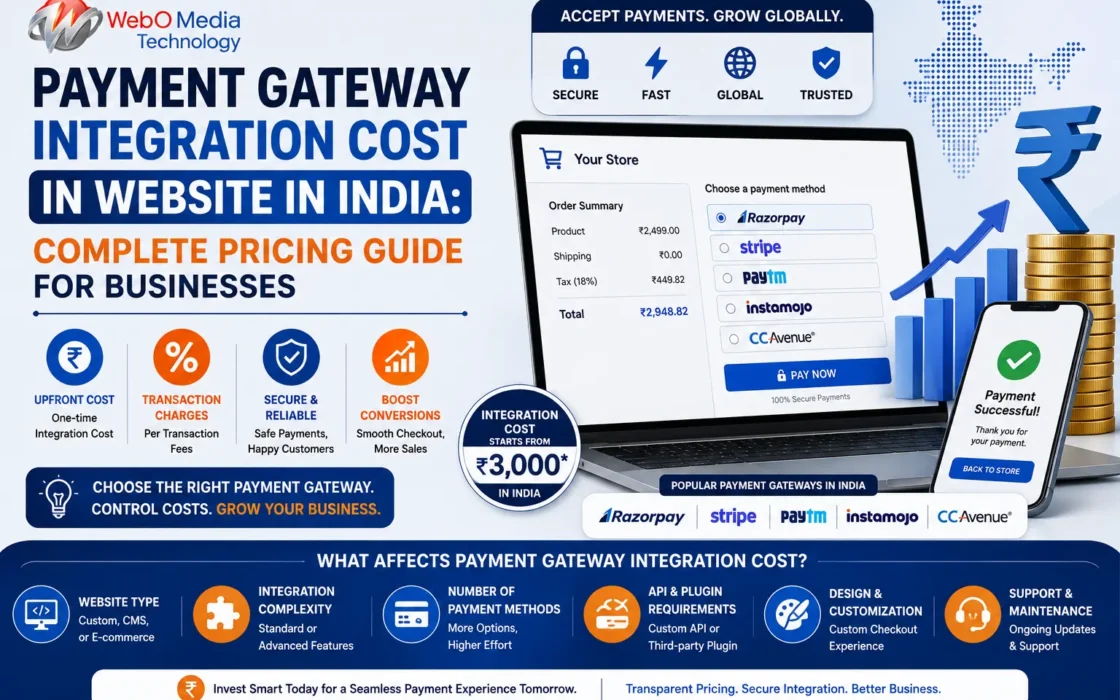
One of the biggest misconceptions is that payment gateway integration has a fixed price. In reality, the cost varies depending on your business requirements and the level of customization involved.
Below is a general estimate of development costs in India.
| Integration Type | Estimated Cost (INR) |
|---|---|
| Basic Payment Gateway Integration | ₹3,000 – ₹10,000 |
| WordPress/WooCommerce Integration | ₹5,000 – ₹15,000 |
| Shopify Payment Gateway Setup | ₹5,000 – ₹12,000 |
| PHP Website Integration | ₹8,000 – ₹25,000 |
| Laravel/Custom Website Integration | ₹15,000 – ₹40,000 |
| Multi-Gateway Integration | ₹20,000 – ₹60,000+ |
| Mobile App Payment Integration | ₹15,000 – ₹50,000 |
These estimates cover development and integration services. Payment gateway providers may also apply setup fees, annual maintenance charges, and transaction fees based on your chosen plan.
What Factors Affect Payment Gateway Integration Cost?
The total payment gateway integration cost depends on much more than simply connecting an API. Several technical and business requirements influence the overall investment.
1. Website Platform
The technology used to build your website significantly affects the integration effort.
For example:
- WordPress websites often require plugin configuration with minimal customization.
- WooCommerce includes built-in compatibility with many payment providers.
- Shopify offers ready-made integrations through supported payment apps.
- Custom PHP or Laravel websites require manual API development.
- Enterprise ecommerce platforms often involve advanced payment workflows.
Custom-built websites typically require more development time than CMS-based websites.
2. Number of Payment Methods
Businesses that only accept UPI and cards require less development than websites supporting multiple payment options.
Additional payment methods may include:
- Wallets
- EMI
- BNPL
- International payments
- Subscription billing
- Auto-debit
- QR payments
The more payment options your website supports, the greater the integration complexity.
3. API Complexity
Some payment gateways provide straightforward APIs, while others require extensive backend development, webhook implementation, and advanced security configurations.
Complex integrations may include:
- Payment status verification
- Refund automation
- Subscription billing
- Split payments
- Marketplace payouts
- Recurring payments
- Tokenized card storage
These advanced features require additional development and testing.
4. Security Requirements
Handling online payments requires strong security practices to protect customer information and prevent fraud.
Professional developers implement:
- SSL certificates
- Secure API authentication
- Data encryption
- HTTPS configuration
- Webhook verification
- Server-side validation
- Fraud detection support
Higher security standards often require additional development effort but are essential for protecting your business and customers.
5. Custom Checkout Experience
Some businesses prefer to redirect users to the payment gateway’s hosted payment page, while others require a fully customized checkout integrated directly into their website.
Custom checkout pages may include:
- Brand-specific design
- One-page checkout
- Coupon integration
- Gift cards
- Loyalty points
- Dynamic shipping calculations
- Tax calculation
- Upselling features
A customized checkout provides a better user experience but typically increases development time and cost.
Payment Gateway Charges vs Website Development Charges
Many business owners confuse payment gateway transaction fees with integration costs. These are two separate expenses.
1. Payment Gateway Charges
These are fees charged by the payment gateway provider and may include:
- Transaction charges
- Annual maintenance fees
- Settlement charges
- International transaction fees
- Refund processing charges
These fees vary depending on the provider and the merchant’s business category.
2. Website Development Charges
These are one-time costs paid to the web development company for integrating the payment gateway into your website.
Development costs generally include:
- API integration
- Payment page configuration
- Checkout customization
- Security implementation
- Testing
- Error handling
- Payment success/failure pages
- Deployment support
Understanding the difference helps businesses budget more accurately for their website project.
Popular Payment Gateways in India
India offers several reliable payment gateway providers, each with unique features, pricing models, and supported payment methods.
Some of the most widely used options include:
- Razorpay
- PayU
- CCAvenue
- Cashfree Payments
- PhonePe Payment Gateway
- Easebuzz
- Instamojo
- BillDesk
- Stripe (for eligible businesses)
- PayPal (primarily for international payments)
When comparing providers, businesses should evaluate:
- Transaction fees
- Settlement time
- Ease of integration
- Customer support
- Supported payment methods
- Security features
- Dashboard and reporting
- Refund management
- International payment support
Choosing the right payment gateway depends on your business model, target audience, expected transaction volume, and future growth plans.
How to Choose the Right Payment Gateway for Your Website
Selecting the lowest-cost provider isn’t always the best decision. The ideal payment gateway should balance affordability, reliability, security, and scalability while meeting your business requirements.
When evaluating payment gateway providers, consider:
- Your website platform
- Business type
- Monthly transaction volume
- Domestic and international payment needs
- Customer payment preferences
- Integration flexibility
- Settlement speed
- Security certifications
- API documentation
- Customer support quality
A gateway that integrates seamlessly with your website and offers dependable support can save time, reduce technical issues, and improve the overall customer experience.
One-Time vs Recurring Payment Gateway Costs
When budgeting for payment gateway integration in India, it’s important to understand that your investment typically includes two categories of expenses: one-time implementation costs and recurring operational charges.
The one-time cost covers the technical work required to integrate the payment gateway into your website or mobile application. Recurring costs, on the other hand, are charged by the payment gateway provider for processing transactions and maintaining the service.
1. One-Time Costs
These costs are generally paid to your web development company and may include:
- Payment gateway API integration
- Custom checkout page development
- Payment success and failure pages
- Testing in sandbox and live environments
- Security implementation
- Webhook configuration
- Deployment support
- Initial technical documentation
For most businesses, this is the primary investment during website development.
2. Recurring Costs
Recurring expenses vary depending on the payment gateway provider and your business model. They may include:
- Transaction processing fees
- Annual maintenance charges (if applicable)
- International payment fees
- Currency conversion fees
- Refund processing charges
- Chargeback fees
- Premium feature subscriptions
Understanding these ongoing costs helps businesses estimate the true cost of accepting online payments.
Hidden Costs Businesses Should Consider
Many businesses focus only on integration charges and overlook additional expenses that may arise after the website goes live. While not every project incurs these costs, it’s wise to plan for them during budgeting.
Potential hidden costs include:
- SSL certificate renewal
- Website hosting upgrades
- Security monitoring
- API version updates
- Third-party plugin licenses
- Website maintenance
- Performance optimization
- Additional payment methods
- Custom feature development
- Technical support
Choosing an experienced web development partner helps minimize unexpected expenses by implementing scalable, future-ready solutions from the beginning.
Payment Gateway Integration Costs by Website Platform
The cost of integrating a payment gateway depends largely on the technology used to build your website. Some platforms offer built-in support, while others require custom API development.
1. WordPress & WooCommerce
WordPress and WooCommerce are among the most popular ecommerce platforms because they support numerous payment gateway plugins.
Typical work includes:
- Plugin configuration
- API credential setup
- Checkout customization
- Payment testing
- Security optimization
Since many gateways already provide WooCommerce plugins, integration is generally faster and more cost-effective.
Estimated Integration Cost: ₹5,000 – ₹15,000
2. Shopify
Shopify provides built-in compatibility with many payment providers, making integration relatively straightforward.
Typical tasks include:
- Payment provider activation
- Checkout configuration
- Tax and shipping setup
- Order testing
Custom checkout functionality may require additional development depending on the Shopify plan.
Estimated Integration Cost: ₹5,000 – ₹12,000
3. Custom PHP Website
Custom PHP websites offer greater flexibility but require manual API integration and extensive testing.
Typical work includes:
- API development
- Custom checkout
- Database integration
- Webhook implementation
- Security validation
Estimated Integration Cost: ₹8,000 – ₹25,000
4. Laravel-Based Ecommerce Website
Laravel is widely used for custom ecommerce applications because of its scalability and security.
Integration often includes:
- API authentication
- Webhook handling
- Payment logging
- Subscription support
- Error management
Estimated Integration Cost: ₹15,000 – ₹40,000
5. Mobile Application Integration
Businesses with Android or iOS applications require payment gateway integration within the mobile app in addition to the website.
This generally includes:
- SDK integration
- Secure authentication
- Payment callbacks
- Order synchronization
- Testing across devices
Estimated Integration Cost: ₹15,000 – ₹50,000
6. PCI DSS Compliance and Payment Security
Security is one of the most important aspects of online payment processing. Customers trust businesses with sensitive financial information, making secure implementation essential.
While many modern payment gateways handle PCI DSS compliance on their own hosted payment pages, your website should still follow best practices to ensure a secure payment environment.
A professional web development team typically implements:
- HTTPS across the website
- SSL certificates
- Secure API communication
- Server-side validation
- Encrypted payment requests
- Tokenized payment processing (where supported)
- Secure webhook verification
- Regular security updates
Investing in security protects your business, builds customer confidence, and reduces the risk of fraud or data breaches.
Common Payment Gateway Integration Mistakes
Even a reliable payment gateway can create issues if it’s not integrated correctly. Many businesses experience payment failures, abandoned checkouts, or security vulnerabilities due to avoidable implementation mistakes.
Some of the most common issues include:
- Choosing the wrong payment gateway for business needs
- Ignoring mobile checkout optimization
- Incomplete payment testing
- Poor error handling
- Missing payment confirmation emails
- Weak checkout user experience
- Improper webhook configuration
- Lack of security validation
- Outdated API versions
- Ignoring payment analytics
Working with experienced developers helps ensure a smooth and reliable payment experience from day one.
How to Reduce Payment Gateway Integration Costs
Businesses often assume that reducing costs means choosing the cheapest solution. In reality, selecting the right technology and planning your project effectively usually delivers better long-term value.
You can optimize costs by:
- Selecting a gateway compatible with your platform
- Finalizing payment requirements before development
- Avoiding unnecessary customizations
- Using supported APIs and plugins where appropriate
- Preparing testing scenarios early
- Consolidating website and payment development under one agency
- Planning future features instead of adding them mid-project
A well-planned project minimizes rework and reduces overall development expenses.
Why Hire a Professional Web Development Company?
Payment gateway integration is more than simply connecting an API. It requires technical expertise, security knowledge, testing experience, and an understanding of ecommerce best practices.
A professional web development company can help you:
- Select the right payment gateway
- Integrate secure payment processing
- Build a smooth checkout experience
- Optimize website performance
- Ensure compatibility across devices
- Implement SEO-friendly development
- Maintain website security
- Provide long-term technical support
An experienced team ensures that your payment system is reliable, scalable, and ready to support your business as it grows.
Why Choose Webomedia Technology?
At Webomedia Technology, we build secure, scalable, and conversion-focused websites that make online payments simple for your customers. Whether you’re launching a startup, an ecommerce store, or a custom web application, our developers integrate trusted payment gateways that provide fast, secure, and seamless transactions.
Our web development services include:
- Custom Website Development
- Ecommerce Website Development
- WordPress Development
- WooCommerce Development
- PHP Website Development
- CMS Website Development
- Payment Gateway API Integration
- Mobile App Development
- Website Maintenance & Support
- Technical SEO Optimization
We work with leading payment gateway providers and follow industry best practices to deliver reliable payment solutions tailored to your business needs.
Frequently Asked Questions (FAQs)
1. How much does payment gateway integration cost in India?
For most websites, payment gateway integration costs between ₹3,000 and ₹25,000, depending on the platform, customization level, and payment features required. Advanced or enterprise-level integrations may cost more.
2. Are payment gateway setup charges separate from transaction fees?
Yes. Integration charges are typically a one-time development cost, while transaction fees are charged by the payment gateway provider for each successful payment.
3. Which payment gateway is best for small businesses in India?
The best choice depends on your business requirements, website platform, and transaction volume. Factors such as pricing, settlement speed, customer support, and available payment methods should all be considered before making a decision.
4. Can I integrate multiple payment gateways into one website?
Yes. Many ecommerce websites integrate multiple payment gateways to provide customers with additional payment options and improve payment success rates.
5. Is payment gateway integration secure?
When implemented correctly using secure APIs, HTTPS, SSL certificates, and industry best practices, payment gateway integration is highly secure and helps protect both businesses and customers.
Conclusion
Understanding the payment gateway integration cost in website in India helps businesses plan their budgets and make informed technology decisions. While the overall cost depends on factors such as platform, customization, payment methods, and security requirements, investing in a professionally integrated payment solution improves customer trust, streamlines transactions, and supports business growth.
Rather than focusing only on the lowest development cost, businesses should evaluate long-term value, reliability, scalability, and security. A well-integrated payment gateway not only simplifies online payments but also enhances the overall user experience, reduces cart abandonment, and increases conversion rates.
By partnering with an experienced web development company, you can ensure your payment gateway is implemented correctly, tested thoroughly, and optimized to support your business today and as it grows in the future.
Need Secure Payment Gateway Integration for Your Website?
Accept online payments with confidence through secure, fast, and reliable payment gateway integration. At Webomedia Technology, we specialize in integrating leading payment gateways for eCommerce websites, business websites, mobile applications, and custom web portals. From API integration and checkout optimization to payment security and ongoing support, we build payment solutions that help your business grow.
🚀 Looking for a secure and scalable payment solution? Our experienced developers help businesses integrate trusted payment gateways, optimize checkout experiences, and build high-performing websites that convert visitors into customers.