

Introduction
Launching an ecommerce website is one of the most effective ways to grow a business, reach new customers, and increase sales. However, before starting a project, one of the most common questions business owners ask is, “How long does it take to build an ecommerce website?”
The answer depends on several factors, including the size of your store, the number of products, custom features, integrations, design requirements, and the development platform you choose. A simple online store can often be completed in a few weeks, while a large custom ecommerce platform may require several months of planning, development, testing, and optimization.
Building an ecommerce website isn’t just about creating attractive pages. It involves designing an intuitive shopping experience, integrating secure payment gateways, optimizing for search engines, ensuring fast performance, and thoroughly testing every feature before launch.
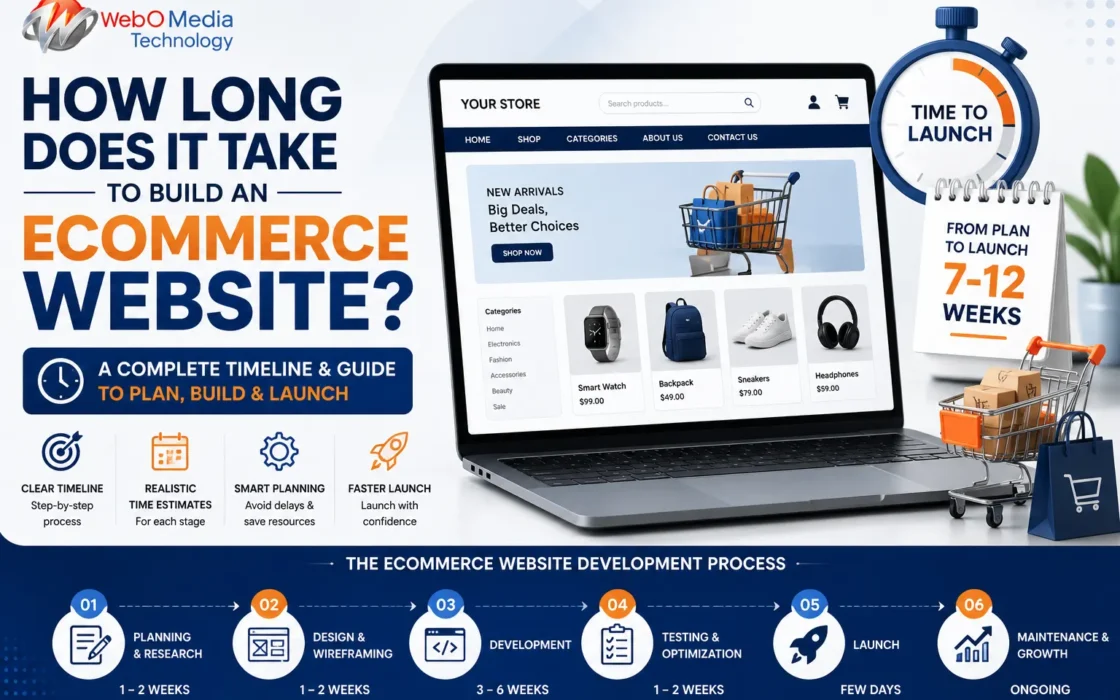
In this comprehensive guide, we’ll explain the complete ecommerce website development timeline, the factors that influence project duration, and what you can expect during each stage of the ecommerce website development process. Whether you’re launching your first online store or upgrading an existing one, this guide will help you plan your project with realistic expectations.
What Is the Average Ecommerce Website Development Timeline?
There isn’t a one-size-fits-all answer because every ecommerce business has different goals and requirements. The complexity of the project has the greatest impact on the development timeline.
Here’s a general estimate:
| Website Type | Estimated Timeline |
|---|---|
| Basic Ecommerce Website | 2–4 Weeks |
| Small Business Online Store | 4–8 Weeks |
| Medium Ecommerce Website | 8–12 Weeks |
| Custom Ecommerce Website | 3–6 Months |
| Enterprise Ecommerce Platform | 6–12 Months |
These estimates assume that project requirements, content, branding assets, and product information are available before development begins. Delays in approvals, content creation, or feature changes can extend the timeline.
What Factors Affect the Ecommerce Website Development Timeline?
Every ecommerce project is unique. Some businesses only require a simple online catalog with basic checkout functionality, while others need advanced features such as inventory synchronization, customer accounts, subscription services, custom product builders, or integrations with ERP and CRM systems.
The biggest factors that influence development time include:
- Number of products
- Custom website design requirements
- Platform selection
- Payment gateway integration
- Shipping configuration
- Third-party software integrations
- Content creation
- SEO implementation
- Mobile responsiveness
- Testing and revisions
The more customized your website becomes, the more planning, development, and quality assurance it requires.
Choosing the Right Ecommerce Platform
One of the earliest decisions in the project is selecting the platform that will power your online store. The right platform depends on your business size, budget, scalability requirements, and technical needs.
Popular ecommerce platforms include:
- Shopify
- WooCommerce
- Magento (Adobe Commerce)
- BigCommerce
- OpenCart
- Custom Laravel or PHP solutions
- Headless Commerce platforms
Each platform offers different levels of flexibility, customization, and development complexity. For example, Shopify is ideal for businesses that need a faster launch with built-in ecommerce functionality, while custom ecommerce development provides greater flexibility for businesses with unique requirements.
Choosing the right platform early helps avoid unnecessary delays later in the project.
Stage 1: Planning and Discovery
Every successful project begins with careful planning. Skipping this stage often leads to unexpected delays, budget overruns, and functionality issues later in development.
During the discovery phase, the development team works closely with the client to understand business goals, target customers, competitors, products, and technical requirements.
Typical planning activities include:
- Business requirement analysis
- Competitor research
- Target audience identification
- Feature planning
- Platform selection
- Sitemap creation
- User journey planning
- Project timeline preparation
This stage ensures everyone involved has a clear understanding of the project’s scope before development begins.
Estimated timeline: 3–7 days
Stage 2: Ecommerce Website Design
Once planning is complete, designers begin creating the visual layout and user experience for the online store. Great ecommerce website design is about much more than aesthetics—it directly influences usability, customer trust, and conversion rates.
Designers focus on creating intuitive navigation, attractive product pages, and a seamless shopping experience across all devices.
The design phase typically includes:
- Homepage design
- Category page layouts
- Product page design
- Shopping cart design
- Checkout flow
- Mobile-responsive layouts
- Brand color implementation
- Typography selection
- User interface improvements
Before development starts, the client reviews and approves the design to ensure it aligns with the brand and business objectives.
Estimated timeline: 1–3 weeks
Stage 3: Ecommerce Website Development
After the design is approved, developers begin transforming the approved layouts into a fully functional ecommerce website. This is usually the most time-intensive stage of the project because it involves building the website’s core functionality and ensuring every feature works smoothly.
The development phase includes both front-end and back-end work. Front-end development focuses on the parts of the website customers interact with, while back-end development manages the database, business logic, user accounts, inventory, and order processing.
During this stage, developers typically:
- Build responsive page layouts
- Develop navigation and menus
- Configure the product catalog
- Set up customer registration and login
- Create shopping cart functionality
- Develop the checkout process
- Configure taxes and currencies
- Optimize website performance
- Implement security best practices
The timeline depends largely on the number of custom features required. A standard ecommerce website can be developed relatively quickly, while advanced functionality requires additional coding and testing.
Estimated timeline: 2–8 weeks
Product Upload and Catalog Management
An ecommerce website isn’t complete without accurate and well-organized product information. Depending on the size of your inventory, uploading products can be one of the most time-consuming parts of the project.
Each product page should include:
- Product title
- Detailed description
- High-quality images
- Pricing
- Product variations
- SKU numbers
- Inventory information
- Shipping details
- SEO metadata
- Product categories
Large ecommerce websitesoften automate this process by importing products from inventory management systems or CSV files, reducing manual effort and improving consistency.
Businesses with thousands of products should plan extra time for product organization and quality checks before launch.
Content Creation for Ecommerce Websites
Content plays a critical role in both user experience and search engine optimization. Many ecommerce projects are delayed because product descriptions, category content, policy pages, and marketing copy are not prepared in advance.
Important content includes:
- Homepage copy
- About Us page
- Category descriptions
- Product descriptions
- FAQs
- Shipping policy
- Return policy
- Privacy policy
- Terms and conditions
- Contact page
High-quality content helps customers make informed purchasing decisions while improving visibility in search engines.
Payment Gateway Integration
Secure payment processing is essential for every online store. During development, payment gateways are integrated and tested to ensure transactions are secure, reliable, and easy for customers.
Popular payment gateways include:
- Stripe
- PayPal
- Razorpay
- Authorize.Net
- Square
- PayU
Developers configure payment settings, test successful and failed transactions, verify security measures, and ensure customers receive accurate order confirmations. This stage is particularly important because payment issues can directly affect sales and customer trust.
Shipping and Tax Configuration
Shipping is another key component of the ecommerce website development process. Customers expect transparent shipping costs, accurate delivery estimates, and multiple delivery options.
Depending on the business model, developers configure:
- Flat-rate shipping
- Weight-based shipping
- Location-based shipping
- Free shipping rules
- Real-time carrier rates
- Local delivery options
- Pickup options
Tax settings are also configured according to regional regulations, ensuring customers are charged correctly during checkout.
Third-Party Integrations
Modern ecommerce businesses often rely on multiple software solutions to manage operations efficiently. Integrating these systems during development saves time after launch and creates a more streamlined workflow.
Common integrations include:
- CRM systems
- ERP software
- Accounting platforms
- Inventory management systems
- Marketing automation tools
- Email marketing platforms
- Live chat software
- Analytics tools
- Customer review platforms
Each additional integration requires planning, configuration, and testing, which can affect the overall project timeline.
SEO Should Begin Before the Website Launches
One of the biggest mistakes businesses make is treating SEO as something to implement after the website is complete. In reality, SEO should be incorporated from the very beginning of the development process.
An SEO-ready ecommerce website is easier for search engines to crawl, faster to load, and better positioned to rank for relevant keywords after launch.
Key SEO tasks during development include:
- Keyword research
- SEO-friendly URL structure
- Optimized page titles
- Meta descriptions
- Header hierarchy (H1–H3)
- Internal linking strategy
- Image optimization
- Schema Markup
- XML sitemap creation
- Mobile optimization
- Core Web Vitals improvements
Integrating SEO early helps avoid expensive revisions later and creates a stronger foundation for long-term organic growth.
Website Testing and Quality Assurance
Before an ecommerce website goes live, every feature should be tested thoroughly to ensure customers enjoy a smooth shopping experience. Even a minor issue, such as a broken checkout button or incorrect shipping calculation, can lead to abandoned carts and lost sales. Quality assurance (QA) helps identify and resolve these problems before launch.
A professional ecommerce website development company performs comprehensive testing to ensure the website functions correctly across different browsers, devices, and operating systems.
Key testing areas include:
- Product search functionality
- Navigation and menus
- Shopping cart performance
- Checkout process
- Payment gateway testing
- Shipping calculations
- Tax configuration
- User registration and login
- Mobile responsiveness
- Browser compatibility
- Contact forms
- Website speed and performance
- Security testing
- Broken links and redirects
Resolving issues during this stage minimizes post-launch problems and improves customer satisfaction. Estimated timeline: 3–7 days
Preparing for Website Launch
Launching an ecommerce website involves more than clicking the “Publish” button. A structured launch plan ensures that every technical and marketing element is in place before customers start visiting your store.
Before going live, developers typically complete the following tasks:
- Connect the website to the live domain
- Install an SSL certificate
- Configure analytics tools
- Set up Google Search Console
- Generate and submit an XML sitemap
- Enable website backups
- Configure email notifications
- Verify payment gateways
- Test order confirmation emails
- Monitor website performance after launch
A successful launch minimizes downtime and ensures that your online store is ready to accept orders from day one.
Common Reasons Ecommerce Website Projects Get Delayed
Although every project begins with a timeline, unexpected delays are common. Most delays are avoidable when businesses and development teams maintain clear communication and prepare project resources in advance.
Some of the most common reasons include:
1. Delayed Content Submission
Product descriptions, images, company information, and policy pages are often delivered late, preventing developers from completing the website.
2. Frequent Design Changes
Making significant design revisions after development has started increases both the timeline and project cost.
3. Scope Creep
Adding new features that weren’t included in the original project plan requires additional development and testing.
4. Third-Party Integration Challenges
Connecting payment gateways, inventory systems, CRM platforms, or shipping providers can sometimes take longer than expected due to API limitations or approval processes.
5. Delayed Client Feedback
Waiting for approvals on designs, functionality, or content can pause development and push back the launch date.
Planning ahead and assigning clear responsibilities helps reduce these delays and keeps the project on schedule.
How to Speed Up Ecommerce Website Development
While every ecommerce website requires careful planning, there are practical ways to reduce development time without compromising quality.
Businesses can accelerate their project by:
- Finalizing requirements before development begins
- Preparing product data and images early
- Choosing the right ecommerce platform
- Using a clear approval process
- Limiting major design revisions
- Selecting experienced developers
- Prioritizing essential features for the initial launch
- Planning future enhancements after launch
Launching a minimum viable ecommerce website (MVP) with essential features first allows businesses to start selling sooner while introducing advanced functionality in later updates.
Should You Choose a Template or Custom Ecommerce Website?
One of the biggest decisions during an ecommerce project is whether to use a pre-built template or invest in custom ecommerce website development.
1. Template-Based Ecommerce Website
A template-based solution is ideal for startups and small businesses looking for a faster and more affordable launch. Platforms such as Shopify and WooCommerce offer professionally designed themes that can be customized to match your brand.
Advantages:
- Faster development
- Lower initial investment
- Proven layouts
- Easier maintenance
- Quicker deployment
2. Custom Ecommerce Website
A custom-built ecommerce website is designed specifically for your business requirements. It offers complete flexibility in design, functionality, and scalability, making it a strong choice for businesses with unique workflows or long-term growth plans.
Advantages:
- Unique design
- Custom functionality
- Better scalability
- Greater flexibility
- Improved performance
- Easier integration with business systems
Choosing the right approach depends on your business goals, budget, and future expansion plans.
Why SEO Should Continue After Website Launch
Launching your ecommerce website is only the beginning of your online growth journey. Search engine optimization is an ongoing process that helps improve visibility, attract qualified visitors, and increase sales over time.
After launch, your SEO strategy should include:
- Publishing informative blog content
- Optimizing product pages
- Updating category descriptions
- Monitoring keyword rankings
- Improving internal linking
- Building high-quality backlinks
- Enhancing Core Web Vitals
- Updating schema markup
- Analyzing Google Search Console data
- Tracking user behavior
Continuous SEO improvements help your ecommerce website remain competitive and adapt to changing search engine algorithms.
Why Hiring an Experienced Ecommerce Website Development Company Matters
Building an ecommerce website involves multiple disciplines, including design, development, security, user experience, SEO, and digital marketing. Working with an experienced ecommerce website development company reduces the risk of costly mistakes and ensures your project is completed efficiently.
An experienced development partner can help you:
- Choose the right platform
- Plan a realistic project timeline
- Build a scalable online store
- Optimize website performance
- Implement SEO best practices
- Improve security and reliability
- Integrate third-party tools
- Provide ongoing maintenance and support
Rather than focusing only on launching a website, a professional development company builds an ecommerce platform that supports long-term business growth.
Frequently Asked Questions (FAQs)
1. How long does it take to build an ecommerce website?
The timeline depends on the project’s complexity. A basic ecommerce website can typically be completed in 2–4 weeks, while custom ecommerce websites may take 3–6 months or longer.
2. What affects the ecommerce website development timeline?
Several factors influence development time, including website size, custom functionality, platform selection, product count, content creation, third-party integrations, and client feedback.
3. Can an ecommerce website be built in one month?
Yes. A standard ecommerce website with a limited number of products and basic functionality can often be launched within four weeks if all content and requirements are ready.
4. Which ecommerce platform is the fastest to launch?
Platforms like Shopify and WooCommerce generally offer faster deployment because they provide built-in ecommerce features and ready-to-use themes.
5. Does SEO increase the website development timeline?
Implementing SEO during development may add a small amount of time initially, but it saves significant effort after launch and helps improve long-term search performance. Building an SEO-friendly website from the beginning is a worthwhile investment.
Final Thoughts
So, how long does it take to build an ecommerce website? The answer depends on your business objectives, website complexity, and the level of customization required. While a simple online store may be ready in just a few weeks, larger ecommerce platforms require additional time for planning, development, testing, and optimization.
Rather than rushing the process, focus on building a website that delivers an excellent user experience, supports future growth, and follows SEO best practices from the start. A well-planned ecommerce website is more than just an online storefront—it is a valuable business asset that can generate leads, increase sales, and strengthen your brand for years to come.
By partnering with an experienced ecommerce website development company and following a structured development process, you can launch a secure, high-performing online store that is designed to grow with your business.
Ready to Build a High-Performing Ecommerce Website?
Whether you’re launching your first online store or upgrading an existing one, Webomedia Technology delivers scalable, SEO-friendly, and conversion-focused ecommerce solutions tailored to your business goals. From planning and UI/UX design to development, payment gateway integration, and post-launch support, we help businesses create online stores that drive traffic, increase sales, and support long-term growth.
🚀 Build an ecommerce website that grows your business. Partner with Webomedia Technology to create a secure, fast, mobile-friendly, and SEO-optimized online store designed to increase conversions and maximize your return on investment.