
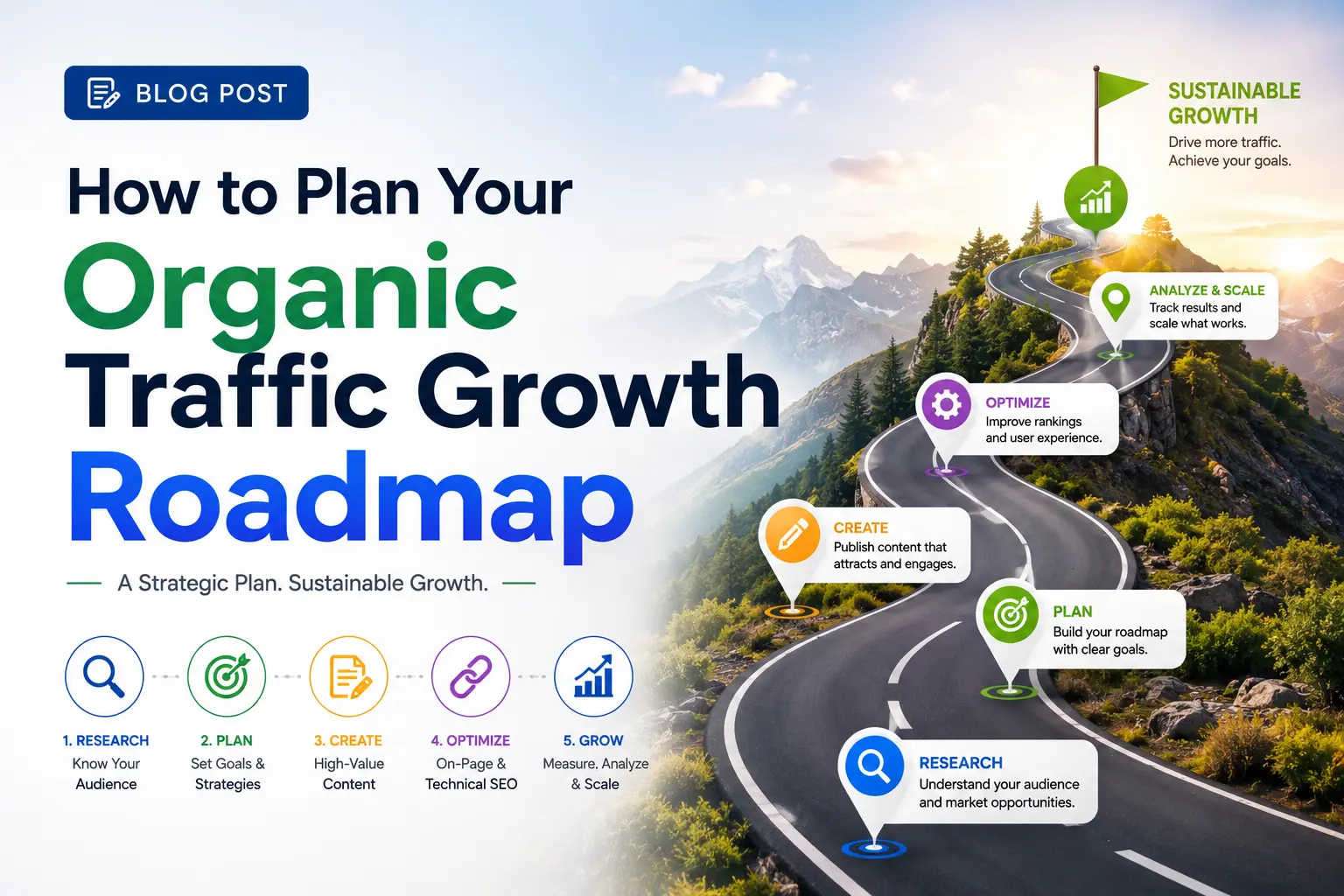
Growing organic traffic is no longer about publishing random blog posts and hoping Google rankings improve over time. In 2026, successful SEO strategies require structure, long-term planning, search intent alignment, technical optimization, and consistent content development.
Businesses that achieve sustainable organic growth usually follow a clear organic traffic growth roadmap instead of relying on isolated SEO tactics.
Whether you run a SaaS company, local business, eCommerce store, agency, startup, or professional service brand, organic traffic has become one of the most valuable digital assets for generating qualified leads, improving online visibility, and reducing customer acquisition costs.
The challenge is that search engines have evolved significantly. Google’s algorithms now evaluate:
- User intent
- Content quality
- Website experience
- Topical authority
- Engagement signals
- Semantic relevance
- Brand trust
- Technical SEO performance
That means businesses need a smarter and more strategic approach to SEO growth.
An effective organic traffic growth roadmap helps businesses:
- Increase search visibility
- Improve keyword rankings
- Generate qualified traffic
- Build topical authority
- Strengthen brand trust
- Improve lead generation
- Support long-term ROI
- Reduce dependence on paid advertising
This guide explains how businesses can create a scalable SEO roadmap that supports sustainable organic traffic growth in modern search environments.
Why an Organic Traffic Growth Roadmap Matters
Many businesses struggle with SEO because they approach it without a structured strategy. They publish inconsistent content, target random keywords, ignore technical SEO, and fail to measure performance correctly.
An organic traffic growth roadmap provides direction and clarity.
Instead of chasing short-term ranking spikes, businesses can focus on building long-term search authority through strategic optimization and content planning.
A strong SEO roadmap helps align:
- Content marketing
- Keyword targeting
- Technical SEO
- User experience
- Conversion optimization
- Link building
- Local SEO
- Brand positioning
Without a roadmap, businesses often waste time producing content that never ranks or attracts qualified traffic.
In competitive industries, SEO success increasingly depends on consistency, topical relevance, and trust-building. Search engines want to recommend businesses that demonstrate expertise and deliver useful experiences for users.
An organized roadmap ensures every SEO effort contributes toward measurable growth objectives rather than disconnected marketing activities.
Start With a Complete SEO Audit
Before planning future organic growth, businesses must understand their current SEO performance.
A comprehensive SEO audit helps identify:
- Technical issues
- Content gaps
- Keyword opportunities
- Indexing problems
- Site speed issues
- Internal linking weaknesses
- Mobile usability concerns
- Conversion bottlenecks
Without a proper audit, businesses often invest in content creation while underlying SEO problems continue limiting search visibility.
Key Areas to Analyze During an SEO Audit
A detailed SEO audit should review:
- Organic traffic trends
- Keyword rankings
- Website structure
- Core Web Vitals
- Mobile responsiveness
- Crawlability
- Duplicate content
- Backlink profile
- Page indexing
- User behavior metrics
Understanding your starting point makes it easier to build a realistic organic traffic growth roadmap with achievable milestones.
Businesses that regularly audit their SEO performance usually adapt faster to algorithm updates and market changes.
Define Clear Organic Growth Goals
One of the biggest SEO mistakes businesses make is focusing only on traffic volume instead of business outcomes.
An effective organic traffic growth roadmap should include measurable goals tied directly to business growth.
Instead of simply aiming for “more traffic,” businesses should define objectives such as:
- Increasing qualified leads
- Improving local search visibility
- Ranking for high-intent keywords
- Growing non-branded traffic
- Improving conversion rates
- Expanding topical authority
- Increasing demo requests or bookings
Clear goals help prioritize SEOefforts and allocate resources more effectively.
For example, a local service business may prioritize Google Business Profile visibility and local keywords, while a SaaS company may focus on informational content and product-led SEO.
SEO becomes far more effective when strategy aligns with actual customer acquisition goals.
Build a Strategic Keyword Research Framework
Keyword research remains one of the foundations of successful SEO, but modern keyword strategy goes far beyond search volume.
In 2026, search engines prioritize intent matching and semantic relevance more heavily than exact-match keyword repetition.
Businesses should build keyword clusters around topics rather than focusing on isolated keywords.
Types of Keywords to Include in Your SEO Roadmap
Your keyword strategy should include:
- Informational keywords
- Commercial intent keywords
- Transactional keywords
- Local SEO keywords
- Long-tail keywords
- Problem-solving searches
- Comparison keywords
- Branded keywords
A balanced keyword strategy helps businesses attract users at different stages of the buying journey.
For example:
- “What is local SEO”
- “Best SEO agency for small businesses”
- “SEO pricing comparison”
- “Google Business Profile optimization services”
Each keyword type supports different conversion opportunities.
Businesses that organize keywords into topic clusters usually build stronger topical authority and improve internal linking opportunities.
Create a Content Marketing Plan Around Search Intent
Content remains one of the strongest drivers of organic traffic growth, but only when it aligns with real user intent.
Publishing generic articles no longer works effectively because Google increasingly rewards useful, experience-driven, and authoritative content.
A successful organic traffic growth roadmap should include a structured content strategy built around:
- Customer pain points
- Search intent
- Industry expertise
- Semantic SEO
- Funnel stages
- Topical relevance
Content Types That Support Organic Growth
Businesses should create a mix of:
- Educational blog content
- Service pages
- Landing pages
- Comparison articles
- Case studies
- Industry guides
- FAQ content
- Localized content
- Evergreen resources
Search engines favor websites that consistently publish high-quality content demonstrating expertise and trustworthiness.
The most successful businesses focus on solving real user problems rather than creating content purely for rankings.
Build Topical Authority Over Time
Topical authority has become one of the most important ranking factors in modern SEO.
Google increasingly rewards websites that demonstrate deep expertise within a specific niche or subject area.
Instead of publishing unrelated content across multiple topics, businesses should focus on building content ecosystems around their core services and expertise.
For example, a digital marketing company may create interconnected content around:
- Local SEO
- Technical SEO
- Google Business Profile optimization
- Content marketing
- Link building
- Conversion optimization
- Search engine algorithms
This creates stronger semantic relationships between pages and improves overall search relevance.
Businesses with strong topical authority often experience:
- Better keyword rankings
- Faster indexing
- Higher organic visibility
- Improved trust signals
- More consistent traffic growth
Topical depth matters far more in 2026 than publishing large amounts of low-quality content.
Improve Technical SEO Foundations
Even excellent content can struggle to rank if technical SEO issues limit search engine accessibility.
Technical SEO helps search engines crawl, understand, and index your website efficiently.
Important Technical SEO Elements
Businesses should optimize:
- Website speed
- Mobile responsiveness
- Site architecture
- XML sitemaps
- Internal linking
- HTTPS security
- Schema markup
- Core Web Vitals
- Canonical tags
- Crawl errors
Google increasingly prioritizes user experience signals when determining rankings.
Slow-loading websites, poor mobile usability, and broken site structures can reduce visibility even when content quality is strong.
Technical optimization supports better crawling, indexing, and engagement performance across the entire website.
Focus on Internal Linking Strategy
Internal linking is one of the most underestimated SEO growth strategies.
A strong internal linking structure helps:
- Improve crawlability
- Distribute page authority
- Strengthen topical relevance
- Increase user engagement
- Improve page discovery
Businesses should strategically connect related pages using natural anchor text and topic relationships.
For example, a blog about local SEO can internally link to:
- Google Business Profile optimization
- Technical SEO services
- Local citation management
- SEO audit pages
Well-structured internal linking improves both search engine understanding and user navigation.
Build High-Quality Backlinks Naturally
Backlinks continue to play an important role in search engine rankings because they help validate authority and trust.
However, modern SEO prioritizes backlink quality over quantity.
Low-quality or manipulative link-building strategies can now damage rankings rather than improve them.
Effective Backlink Strategies for Organic Growth
Businesses should focus on:
- Digital PR
- Industry partnerships
- Guest contributions
- Local business mentions
- Data-driven content
- Thought leadership
- Resource pages
- Community involvement
Strong backlinks improve:
- Domain authority
- Search visibility
- Brand credibility
- Referral traffic
- Competitive positioning
The best backlink strategies are usually built around creating genuinely valuable content people naturally want to reference.
Optimize for Mobile Search Experience
Most organic searches now happen on mobile devices, making mobile optimization critical for SEO success.
A poor mobile experience increases bounce rates and reduces engagement signals, which can negatively affect rankings.
Mobile SEO Optimization Priorities
Businesses should improve:
- Mobile responsiveness
- Page speed
- Navigation simplicity
- Readability
- Click-to-call functionality
- Mobile UX design
Google’s mobile-first indexing means your mobile experience directly impacts search performance.
Fast, user-friendly mobile websites generally experience stronger engagement and conversion rates.
Track SEO Performance Consistently
SEO growth becomes difficult to scale without accurate performance tracking.
Businesses should regularly analyze:
- Organic traffic growth
- Keyword rankings
- Conversion rates
- Bounce rates
- Click-through rates
- User engagement
- Indexed pages
- Backlink growth
Tracking helps businesses identify which strategies are generating results and where optimization opportunities exist.
Key SEO Metrics to Monitor
Important metrics include:
- Organic sessions
- Non-branded traffic
- Average ranking positions
- Search impressions
- Goal completions
- Page engagement
- Returning visitors
SEO is an ongoing process. Businesses that continuously refine their roadmap based on real data usually achieve more sustainable long-term growth.
Adapt Your SEO Strategy for AI Search in 2026
AI-powered search experiences are changing how users discover information online.
Search engines increasingly prioritize:
- Contextual relevance
- Experience-driven content
- User satisfaction
- Semantic understanding
- Brand authority
- Trust signals
That means businesses can no longer rely only on traditional keyword optimization.
Modern SEO requires:
- Helpful content
- Strong topical authority
- Real expertise
- Better user experiences
- Consistent brand trust
Businesses that adapt early to AI-driven search behavior are more likely to maintain long-term organic visibility.
Common Mistakes That Hurt Organic Traffic Growth
Many businesses unknowingly limit SEO growth through poor strategic decisions.
Mistakes to Avoid
1. Publishing Low-Quality Content
Thin or generic content rarely performs well in modern search results.
2. Ignoring Technical SEO
Technical issues can prevent strong content from ranking effectively.
3. Targeting the Wrong Keywords
High-volume keywords without intent alignment often generate poor conversions.
4. Inconsistent Content Publishing
SEO growth requires consistency over time.
5. Weak Internal Linking
Disconnected pages reduce topical authority.
6. Neglecting User Experience
Poor UX can hurt engagement and rankings.
Avoiding these mistakes helps businesses build more stable and sustainable organic growth.
Frequently Asked Questions
1. What is an organic traffic growth roadmap?
An organic traffic growth roadmap is a structured SEO strategy that outlines how a business will increase search visibility, rankings, and organic website traffic over time.
2. How long does organic traffic growth take?
SEO growth timelines vary depending on competition, website authority, and strategy quality. Most businesses begin seeing meaningful improvements within several months.
3. Why is topical authority important for SEO?
Topical authority helps search engines understand your expertise within a specific niche, improving rankings and visibility across related searches.
4. Does technical SEO still matter in 2026?
Yes. Technical SEO remains essential for crawlability, indexing, mobile usability, and user experience optimization.
6. Can content marketing improve organic traffic?
Absolutely. High-quality content aligned with search intent remains one of the strongest drivers of sustainable organic traffic growth.
Conclusion
Building a successful organic traffic growth roadmap requires much more than publishing occasional blog posts or targeting random keywords.
In 2026, SEO success depends on strategic planning, technical optimization, search intent alignment, topical authority, content quality, and continuous performance improvement.
Businesses that invest in structured SEO roadmaps are far more likely to:
- Increase search rankings
- Generate qualified traffic
- Improve conversion rates
- Build brand authority
- Strengthen online visibility
- Achieve long-term marketing ROI
The businesses dominating organic search today are the ones treating SEO as a long-term business growth system rather than a short-term traffic tactic.
Ready to Build Your Organic Traffic Growth Strategy?
If your business wants to improve search visibility, attract qualified leads, and build sustainable organic growth, creating a structured SEO roadmap is one of the smartest long-term investments you can make.
A properly planned organic traffic strategy helps businesses compete more effectively in modern search environments while building stronger trust, authority, and customer acquisition opportunities over time.
At Webomedia Technology, we help businesses build data-driven SEO strategies that generate sustainable organic traffic, qualified leads, and long-term search visibility.
From technical SEO and content marketing to local SEO, Google Business Profile optimization, and conversion-focused website strategies, our team creates customized growth roadmaps designed around your business goals — not generic SEO tactics.
Whether you’re a local business, SaaS company, eCommerce brand, startup, or professional service provider, we help you compete smarter in modern search results and turn organic traffic into measurable business growth.